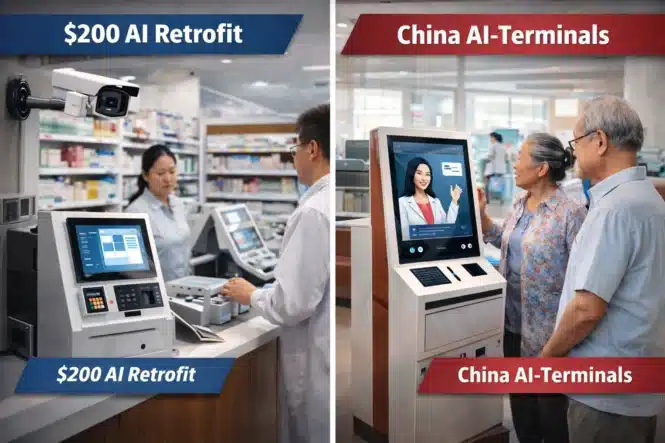
Summary — $200 AI Retrofit vs. China’s AI-Native Smart Terminals
1. The $200 AI Retrofit Model
This approach upgrades existing kiosk fleets with inexpensive AI accelerators (such as edge inference modules).
Characteristics
-
Add-on hardware module (~$200)
-
Installed inside legacy kiosks already deployed
-
Enables computer vision, gesture recognition, analytics, or voice AI without replacing the system.
Advantages
-
Extremely low cost compared with full replacement
-
Protects existing investments in kiosks already deployed
-
Quick deployment across large fleets
-
Works well in mature markets with large installed bases.
Limitations
-
Performance constrained by legacy hardware architecture
-
Limited sensors and integration compared with modern systems
-
AI is an add-on capability, not the core design principle.
2. China’s AI-Native Smart Terminal Model
In contrast, many new Chinese deployments are built from the ground up with AI as the core system layer.
Characteristics
-
New hardware platform designed for AI from day one
-
Integrated sensors (vision, biometrics, microphones)
-
Local AI inference engines
-
Designed for autonomous service workflows.
Advantages
-
Full AI integration across hardware and software
-
Enables advanced capabilities such as:
-
biometric identification
-
AI diagnosis or consultation
-
smart retail automation
-
robotic service interaction.
-
-
Scales well for smart cities, healthcare booths, and autonomous retail.
Limitations
-
Much higher capital cost
-
Requires new deployments instead of upgrading existing fleets.
Strategic Insight
The article’s broader argument:
-
Western markets: tend to retrofit AI into existing infrastructure to control cost and extend asset life.
-
China and some emerging markets: are increasingly deploying AI-native infrastructure, which may enable faster innovation and leapfrog legacy systems.
This difference mirrors a broader technology pattern where retrofit systems generate incremental improvements, while AI-native platforms enable new service models and automation levels.
Bottom Line
-
Retrofit AI ($200 upgrade): practical and cost-efficient for large installed kiosk fleets.
-
AI-native terminals: more expensive but unlock deeper automation and new services.
In short:
Retrofit = modernization of the past.
AI-native = infrastructure for the next generation.
More Resources

