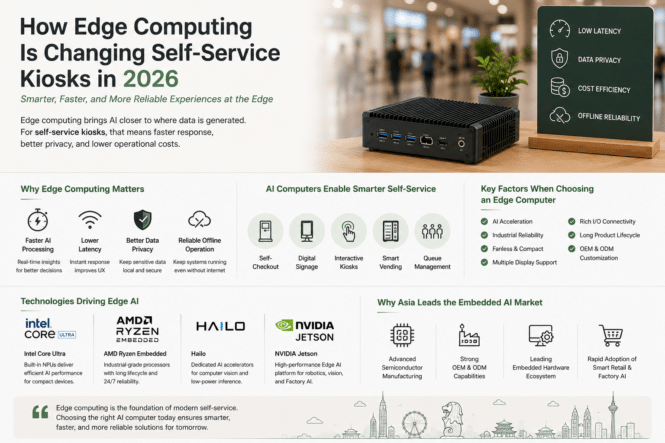
Self-service technology is becoming smarter, faster, and more efficient thanks to edge computing. Instead of sending data to the cloud, today’s edge computers process AI workloads locally, enabling real-time decisions for kiosks, digital signage, and smart retail.
As businesses continue investing in automation, choosing the right AI computer has become a key factor in delivering reliable customer experiences.
Why Businesses Are Moving to Edge Computing
Cloud computing works well for centralized data processing, but many self-service applications require immediate responses.
By processing information locally, edge computing offers several advantages:
- Faster response times
- Lower network latency
- Better customer privacy
- Reduced cloud costs
- Stable performance during internet outages
For retailers and kiosk operators, these benefits improve both efficiency and customer satisfaction.
AI Computers Built for the Edge
Modern AI computers combine high-performance processors with dedicated AI acceleration, allowing applications such as:
- Self-checkout
- Interactive kiosks
- Smart vending
- Digital signage
- Computer vision
- Queue management
These systems can analyze images, recognize objects, and process voice commands without depending entirely on cloud services.
Choosing the Right Edge Computer
When selecting an edge computer, system integrators should evaluate more than processor performance.
Important considerations include:
- AI acceleration (NPU or GPU)
- Industrial reliability
- Fanless operation
- Multiple display support
- Rich I/O connectivity
- Long product lifecycle
- OEM and ODM customization
Industrial-grade hardware is often better suited for 24/7 commercial environments than consumer PCs.
Leading Edge AI Platforms
Several hardware platforms are driving the adoption of embedded AI in self-service applications.
Intel Core Ultra provides integrated NPUs for efficient on-device AI processing.
AMD Ryzen Embedded offers industrial-grade performance with long-term availability.
Hailo delivers dedicated AI acceleration for computer vision and low-power inference.
NVIDIA Jetson supports advanced Edge AI applications, including robotics, machine vision, and Factory AI.
Each platform serves different deployment needs depending on power requirements, AI workloads, and system complexity.
Why Asia Leads the Embedded AI Market
Asia continues to dominate the embedded computing industry through:
- Advanced semiconductor manufacturing
- Strong OEM and ODM capabilities
- Mature embedded hardware ecosystem
- Rapid adoption of smart retail technologies
These strengths allow manufacturers to deliver innovative AI solutions while maintaining competitive costs and scalable production.
Final Thoughts
The future of self-service technology depends on intelligent edge devices capable of processing AI locally.
As demand for smart retail, digital signage, and automated kiosks grows, edge computing, AI computers, and industrial edge computers will become the foundation of next-generation deployments.
For businesses planning future projects, selecting the right embedded AI platform today will help ensure better performance, scalability, and long-term reliability.
More Resources
- How to Choose the Best Mini PC for Kiosks and Digital Signage in 202
- Why LG’s Enterprise Strategy Signals the Future of Smart Building and Digital Signage
- China’s Crackdown on Ghost Kitchens Signals a New Era for Food Delivery Platforms
- Computex 2026: Why Edge AI Is Becoming the Real Engine Behind Smart Retail
- LG Electronics Launches Ultra-Low-Power “LG E-Paper Display” for Commercial Spaces


