Smart vending machines are rapidly evolving into AI retail platforms, transforming the future of automated retail systems and modern commerce. For decades, smart vending machines were simple devices designed to sell snacks and beverages. Today, powered by AI, data, and automation, smart vending machines are no longer standalone machines but intelligent retail systems integrating payment, inventory management, and… Read More »
The China shopping mall is rapidly evolving into autonomous shopping malls and autonomous commercial ecosystems, powered by advanced digital retail infrastructure in China. These new-generation smart malls in China are no longer traditional retail spaces. Instead, they are becoming fully integrated, system-driven environments where consumers can complete the entire shopping journey through self-service retail systems and digital automation. Insight by Intel By Craig Keefner TingTing’s report highlights… Read More »
The Smart Cinema in China industry is undergoing a rapid transformation—from traditional exhibition spaces into fully digitized, self-service, AI-driven environments. On the computer side note the shift toward Intel Core Ultra (NPU-equipped) mini-PCs inside these kiosks to handle real-time demographic recognition and gaze analysis without high latency or massive cloud egress cost. Our Executive Takeaway By Craig Allen Keefner — China’s cinema… Read More »
The healthcare shanghai kiosk for the public with AI, deployed, everywhere. China just put doctors inside vending machines, and they diagnose you in 4 minutes with 95% accuracy. ✅ 2,200 AI health kiosks deployed nationwide ✅ Trained on 300 million medical consultations ✅ 70% faster, 30% cheaper, human doctor still verifies This isn’t a pilot. It’s fully operational.… Read More »
The Perfect Environment for Self-Service China has built the world’s most scalable self-service ecosystem—not because of superior hardware, but because of a frictionless QR code payment infrastructure led by Alipay and WeChat. With QR payments deeply embedded into daily behavior, China has removed the biggest constraint in kiosk deployment: payment integration complexity. The result is a high-growth, high-density self-service market that continues to outpace… Read More »
identity integration (Keycloak), accessibility hardware, power/device control, and a more modern, stable technical base. https://kioskindustry.org/interactive-digital-software-sitekiosk/ Key new capabilities Identity & security Keycloak is now supported as an identity provider for both cloud and on‑prem deployments, extending SSO and user management integration options (setup requires consultation). Accessibility & input hardware Adds support for the ANKER EAA‑Pad as an accessibility device, broadening supported accessible usage scenarios on kiosks. See EAA Checklist for Accessible Kiosk Design Power and device management Supports Nexmosphere NEO for power management, enabling more advanced use cases where display power supply and device control are relevant (e.g., turning peripherals on/off). Platform and editor updates Editor fixes Fixes issues in the project editor when handling .webp and .gif images, improving reliability for asset-heavy layouts. Runtime stack refresh Updates the client platform to Electron 40.5.0 with Chromium 144.0.7559.177, giving a more current browser engine for stability, security, and compatibility in continuous operation. [144 is a January 2026 stable and extended‑stable branch (now also LTC/LTS in some ChromeOS channels). General stability Includes additional unspecified bug fixes and optimizations across the platform. Practical implications Better fit into enterprise IAM stacks (via Keycloak) in both cloud and on‑prem kiosk/signage environments. Stronger accessibility story at the hardware level (EAA‑Pad) on top of the earlier accessibility features introduced in 1.7–1.8. Improved options for interactive retail or DOOH scenarios where power control and sensor-driven experiences via Nexmosphere gear matter. Reduced risk from an aging embedded Chromium and fewer editor hiccups with modern image formats. Definitions Keycloak is an open‑source identity and access management (IAM) platform used to handle authentication, single sign‑on, and authorization for applications and APIs. Core idea Runs as a central identity provider (IdP) that apps trust for login, logout, and token issuance instead of each app managing its own accounts. What it provides Single sign‑on and single logout across multiple web, mobile, and backend apps using OpenID Connect and SAML. User management, roles, and groups, including integration with LDAP/Active Directory or external IdPs (Google, Azure AD, etc.). Identity brokering and federation so you can plug multiple identity sources into one consistent login experience. In kiosk/digital signage terms, it’s the central SSO service your players, CMS, and admin portals can delegate login to, instead of each system rolling its own auth.
https://kioskindustry.org/facial-recognition-kiosk-hardware-a-buyers-guide/ Executive Checklist 1Architecture & Data Ownership ☐ Edge vs Cloud vs Hybrid clearly defined ☐ Biometric templates stored where? (device / on-prem / cloud) ☐ Data ownership contractually assigned (not vendor-controlled) ☐ Retention + deletion policies documented 2Regulatory & Compliance ☐ BIPA (Illinois), GDPR (EU), and regional laws evaluated ☐ Explicit consent / opt-in workflows implemented ☐ Audit trail + logging enabled ☐ Accessibility (ADA / EN 301 549 / EAA) considered 3Accuracy & Performance ☐ FAR (False Accept Rate) meets use case threshold ☐ FRR (False Reject Rate) acceptable for throughput ☐ Performance validated across lighting / demographics ☐ Mask / occlusion handling tested FAR (False Accept Rate): Probability that the system incorrectly matches an unauthorized person.FRR (False Reject Rate): Probability that the system rejects an authorized user. 4Throughput & Operations ☐ Transactions per minute benchmarked ☐ Average authentication time measured ☐ Queue impact modeled for peak usage ☐ Fallback flow defined (QR / PIN / staff assist) 5Security & Spoofing Protection ☐ Liveness detection (active/passive) ☐ Anti-spoofing certified (ISO/IEC 30107 or equivalent) ☐ Protection against replay / deepfake attacks ☐ Hardware root of trust (TPM 2.0 / secure enclave) ☐ Measured boot / remote attestation capability ☐ Full disk + biometric template encryption Liveness Detection: Techniques used to verify a real, live person is present (not a photo, video, or deepfake). 5A.Trusted Platform Security. ☐ TPM 2.0 or equivalent hardware root of trust present ☐ Secure boot chain enforced ☐ Remote device attestation supported ☐ Key storage isolated from OS (no software-only keys) ☐ Compliance with enterprise endpoint security policies 6Hardware & Environment ☐ Camera quality aligned with use case (not consumer-grade) ☐ Lighting conditions validated (indoor/outdoor) ☐ ADA height and reach compliance ☐ Environmental durability (heat, glare, vandalism) 7Edge AI Strategy ☐ On-device inference for latency/privacy ☐ Offline capability (network failure scenarios) ☐ AI model update strategy defined ☐ Compute platform lifecycle (5–7 years) validated 8Integration Stack ☐ IAM / identity platform integration ☐ POS / payments (face-pay?) integration ☐ EHR (healthcare) or enterprise backend integration ☐ API-first architecture IAM (Identity and Access Management): Enterprise system that manages user identities, authentication, and authorization. API (Application Programming Interface): Interface that allows the kiosk to integrate with backend systems such as payments, identity, or healthcare records. 9User Adoption & UX ☐ Enrollment friction minimized ☐ Clear user consent messaging ☐ Multi-modal fallback (don’t force biometrics)… Read More »
Powers Next Generation of Commercial PCs Built on Intel 18A March 25, 2026Published Intel’s commercial portfolio powers 125+ designs across enterprise, education, government and SMB—delivering scale, security and AI for the modern workplace NEWS HIGHLIGHTS: Intel Core Ultra Series 3 for Business PCs: Built on Intel 18A, Intel’s newest leading-edge node for commercial PCs, powering a full spectrum of devices from laptops to advanced workstations. Intel vPro Platform Leadership: Advanced security, AI-driven manageability and easy fleet service activation, drive more… Read More »
National Restaurant Show — See Association of Kiosk Manufacturers The National Restaurant Association Show returns to Chicago from May 16–19, 2026, bringing together the full spectrum of foodservice innovation—from global brands to emerging technology providers shaping the future of hospitality. Held at McCormick Place, the event serves as a central hub for operators, IT leaders, and solution providers focused on improving efficiency, customer experience, and profitability. Visit Booth 5829 in the North Building to explore the latest in self-service kiosks, digital ordering, contactless engagement, and edge-powered restaurant technology designed to meet the evolving demands of modern foodservice environments. What and Where To See Floorplan Registration Schedule What To See in our booth Vispero — accessibility for quick serve restaurants and self-order kiosks Pyramid Computer – Kiosks — two different self-order kiosks Set up a Meeting text 720-324-1837 whatsapp or wechat — (
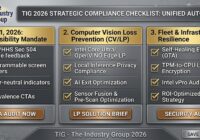
2026 Strategic Compliance Checklist In 2026, compliance is no longer a legal review process—it is a system architecture decision. Organizations deploying kiosks, self-checkout, or unattended retail must now design for accessibility, AI-driven loss prevention, and zero-trust security from day one. This checklist is not theoretical. It reflects what regulators, auditors, and operations teams will actually enforce in production environments. The 2026 compliance landscape has moved from “best practice” to legal mandate, with a specific focus on two areas: the May 11, 2026, HHS Section 504 deadline and the shift toward Computer Vision (CV) as the standard for loss prevention. Below is the consolidated 2026 Strategic Compliance Checklist derived from recent industry guides and regulatory updates. “2026 compliance = accessibility + edge AI + zero trust” “Design-time requirement, not retrofit” “Failure = legal exposure + operational breakdown” Table of Contents 1Healthcare & Public Access (The May 11 Deadline) The HHS Section 504 rule is the most immediate regulatory hurdle for organizations with 15+ employees. [ ] Tactile Integration: Kiosks must be operable by keyboard or tactile input alone; scheduling and payment interfaces cannot rely on touch-only or mouse-driven flows. [ ] Non-Visual Feedback: Images, diagrams, and status indicators (like error alerts) must have meaningful audio descriptions or “programmatically associated” labels for screen readers. [ ] Color Neutrality: Critical information (e.g., “Required Field” or “Transaction Failed”) cannot be conveyed by color alone (e.g., just turning the box red). [ ] Privacy Equivalence: Alternative procedures for those who cannot use a kiosk must afford the same level of confidentiality and convenience as the digital transaction. 2Retail Shrink & AI Loss Prevention (The “Edge AI” Standard) Retail shrink—now exceeding $100B annually—has moved Computer Vision from pilot to required infrastructure. [ ] Sensor Fusion (The “Anti-Swap” Protocol): Move beyond simple weight scales. Systems must now integrate CV with transactional data to detect “ticket switching” or “mismatched item” events in real-time. [ ] Local Inference (Privacy Compliance): To meet 2026 data privacy standards, CV must run on Edge AI hardware (e.g., Intel Core Ultra with OpenVINO). PHI and biometric data should be processed on the device, not streamed to the cloud. [ ] AI Exit Compatibility: Packaging and labeling must be optimized for “Scan & Go” AI exit systems to reduce manual employee checks at the door. [ ] “Pre-Scan” Optimization: Ensure kiosk workflows are compatible with “pre-scan” technologies used by staff to assist high-volume checkout zones. 3Operational Resilience & Security With $400B in annual downtime losses, “Infrastructure-Grade” kiosks must meet new Resilience Standards. [ ] Self-Healing Endpoints: Kiosks must be configured with “Persistence” technology that allows security software to autonomously reinstall or repair itself if tampered with physically or remotely. [ ] Zero-Trust Policy Sync: Fleet management (UEM) must enforce identical security and accessibility configurations across the entire fleet (Windows, Android, or iPadOS) over-the-air (OTA). [ ] TPM-to-CPU Encryption: Protect against “bus attacks” on unattended terminals by ensuring hardware-level encryption of the link between the Trusted Platform Module and the CPU. Pro Tip — If you spec Dell / HP / Lenovo inside kiosks: You are almost always getting firmware TPM You don’t control TPM vendor anymore If you need: FIPS certification Hardware isolation High-assurance identity Then you must explicitly spec: Industrial board (Advantech, AAEON, etc.) With Infineon / Nuvoton discrete TPM Discrete TPM (Infineon, Nuvoton, ST) — Was the Default: Still critical But now only in regulated, embedded, or long-lifecycle deployments Top 4 Failure Modes (2026) Retrofitting accessibility instead of designing it in Cloud-dependent AI violating privacy expectations Consumer hardware deployed in 5–7 year lifecycle environments Inconsistent fleet configurations breaking compliance at scale Intel-Specific Hardware Update Intel’s “Store-in-a-Box” reference architecture is now the benchmark for this checklist. By utilizing the vPro management layer, operators can remotely audit a fleet’s ADA Compliance state and AI Inference health without a truck roll—a critical requirement for 2026 ROI. Intel’s “Store-in-a-Box” (also referred to as the Autonomous Micro-Store architecture) is a modular, high-performance edge computing framework designed to convert traditional retail spaces into fully automated, “frictionless” environments. Rather than relying on a massive, expensive cloud-based backend, this architecture pushes the “intelligence” to the physical store itself. Core Components of the Architecture High-Performance Edge Nodes: The system is anchored by Intel Core Ultra or Xeon processors located on-site. These provide the raw horsepower needed to handle hundreds of data streams simultaneously without the latency issues of the cloud. Intel OpenVINO Toolkit: This is the “brain” of the operation. It allows the store to run complex Computer Vision (CV) models to track customer movement, identify products being picked up, and manage real-time inventory. In 2026, this is the primary tool for catching “ticket switching” or mis-scans at self-checkout. Intel vPro Technology: For the operator, this is the management layer. It allows for remote, hardware-level management of the entire store. If a kiosk or sensor fails, IT can power-cycle or repair the software “out-of-band” without sending a technician to the physical site.… Read More »