Patents are not a roadmap. They are an early map of the options a retailer is serious enough to protect.
- PDF Paper – What Walmart Patents Reveal
- Technology Radar
- Walmart Patent Intelligence
- Walmart Patent Family Appendix (xls)
- These will be available on Gumroad shortly
The shared conclusion
Both analyses argue that Walmart’s patent activity does not point to one dramatic “store of the future” product, such as a universal cashierless store. Instead, it suggests a layered stack:
-
Instrument the shelf, inventory, checkout, and fulfillment process.
-
Connect activity through transaction, item, and customer data.
-
Apply computer vision, RFID, AI, and workflow automation.
-
Use the resulting data for retail media, personalization, fulfillment, and operating efficiency.
The strongest common signals are:
Both pieces also get the central analytical discipline right: a patent is a signal of possible strategic interest, not proof of a product plan. The most meaningful findings are where a patent family is reinforced by repeat inventors, continuations, supplier relationships, pilots, acquisitions, public deployments, and Walmart operating announcements.
Take 1: Broad strategic thesis
Take 1 is closer to an executive patent-intelligence briefing. It opens with portfolio scale, filing cadence, inventor concentration, geographic patterns, and a seven-domain strategic map. It then ranks Walmart’s future strategic hypotheses for the next three to seven years.
What it does well
-
It gives you a big-picture narrative: Walmart’s filing activity appears to have moved from the more speculative 2016–2019 era—drones, VR, biometric carts, audio surveillance—toward a smaller, more operationally focused set of technologies after 2021.
-
It applies an explicit confidence framework:
-
Defensive/speculative
-
Enabling capability
-
Active pilot
-
Likely commercialization signal
-
-
It properly identifies the strongest patent-to-business connections:
-
Sam’s Club exit verification
-
RFID expansion
-
digital shelf labels
-
Vizio/retail media
-
Alert Innovation and fulfillment automation
-
Wallaby/Sparky and AI commerce
-
-
Its best high-level insight is that Walmart is creating an “instrumented store operating system”: each shelf, item, transaction, associate task, fulfillment movement, and customer interaction becomes measurable and increasingly automatable.
What needs tightening
The first take is occasionally too sweeping and contains claims that need harder source validation before being published as fact. A few examples:
-
Patent-document and family counts, grant rates, annual filing figures, and citation statistics should be traceable to a named database, defined search methodology, and retrieval date.
-
Statements such as “Sam’s Club had exit arches at all ~600 clubs by the end of 2024” or highly specific performance results deserve direct primary-source corroboration.
-
The statement that the Vizio/Onn combination could reach “25–30% of U.S. households” is a major claim and needs an especially strong source or should be framed as an external estimate.
-
References to future-dated grants or events require careful date checking and patent-record verification before use.
-
The opening patent-count discussion risks burying the reader in numbers before the operational story is clear.
TAKE ONE
Walmart Inc. Patent Portfolio Analysis (ca. 2011–2026, emphasis on 2021–2026)
0. Methodology and Portfolio-Level Baseline
This analysis triangulates USPTO-published grants and applications for the assignee family Wal-Mart Stores, Inc. / Walmart Inc. / Walmart Apollo, LLC (Walmart’s IP holding vehicle, which received a bulk assignment from Wal-Mart Stores, Inc. recorded at reel 45817), plus patents from acquired entities (Alert Innovation, Vizio/Inscape, Aspectiva, Jet.com lineage) and third-party patent analytics (GreyB, IFI CLAIMS, PatSnap). Caveats: U.S. applications publish ~18 months after filing, so 2024–2025 filing counts are understated; Walmart files heavily but states it does not commercialize most filings (“We file patents frequently but that doesn’t mean the patents will actually be implemented”
-
~7,746 patent documents globally across ~3,680 unique families, with >93% still active; the USPTO portion shows 3,158 applications and a 61.3% grant rate with ~2.6-year average pendency.
-
Geographic coverage: US-dominant (4,368 documents), followed by Canada (749), UK (519), Mexico (490), India (150), China (102). R&D-family geography concentrates in the US (3,369) with India second (247) — i.e., Bentonville/Walmart Global Tech plus the Bangalore/Chennai hubs.
-
Cadence: Published applications peaked in 2017–2019 (1,676 / 1,383 / 1,201 per year), then dropped to the 240–450/yr range for 2020–2023 (2024 shows only 16 published, a pure publication-lag artifact). Grants have stayed persistent at ~300–490/year, and 2024–2026 grants skew heavily toward shelf computer vision, ASRS/fulfillment robotics, labor scheduling, ML pricing, and conversational AI. So: a speculative-filing surge 2016–2019 has matured into a smaller, more operations-focused, prosecution-heavy portfolio.
Inventor concentration: the portfolio is highly concentrated in repeat inventor groups — Donald R. High (~191 filings) and Kannan Achan (~160) top the list
- 2024–2025 grants reveal stable teams: the Zhang/Pachauri group (shelf-image product identification), the Tomar group (ASRS container merging), the Achan/Inan/Cho/Kumar group (recommendations, membership scoring), and the Bryan/Brooks/Brightwell group (perpetual-inventory corrections) — evidence of persistent, mission-aligned R&D cells rather than one-off invention harvesting
- Assertion leverage: Walmart is also a cited-prior-art giant — its patents were used in 4,579 §102/§103 rejections, most often against IBM, Toshiba, Microsoft, and Amazon (49 rejected Amazon applications).
1. Frictionless & Assisted Checkout (Scan & Go, CV checkout, smart carts, payment)
Technical approach. A decade-long arc: RFID-based automated cart checkout (2008 filing, granted 2014 — RFID interrogation zone + camera audit; the 2014 refile never granted)
- cart-basket weight monitoring (2013→2017); motorized self-driving carts with detachable motors, cameras and shelf-auditing ability (2016 filing)
- then a pivot to verification-at-exit rather than skip-the-register: Sam’s Club’s computer-vision exit arches match cart contents to receipts in seconds.
Adjacency/commercial evidence (strong). Sam’s Club’s exit tech — built in-house — hit 120+ clubs (~20%) by April 2024 with members exiting 23% faster, and was at all ~600 clubs by end-2024, with >75% of members exiting unstopped Walmart notably contrasted this with Amazon’s Just Walk Out retreat
- NCR Voyix/Toshiba/Diebold Nixdorf hold SCO-vision IP but Walmart is insourcing this layer.
2. Loss Prevention, Exception Detection, RFID, Video Analytics, Biometrics
Technical approach. Dense CV-for-shrink IP: US 12,067,549 “systems and methods of image processing and shrinkage evaluation” (gradient-amplitude histograms counting items from overhead camera pixels — granted 2024, filed 2022, inventors Chunmei Wang, Zhichun Xiao, Walmart Global Tech Texas) a 2017-filed “listening to the frontend” audio-analytics patent for bag/rustle/register-sound employee-performance metrics (granted 2018, publicly disavowed for implementation) plus widely reported speculative filings of the 2018 era (biometric-sensing carts, in-store drones). On identity: Sam’s Club explicitly designed exit CV to avoid biometrics/facial recognition
3. Store Operations, Labor, Shelf Intelligence, Pricing, Digital Shelf Labels
Technical approach (and it’s the densest current cluster). Recent grants include: mobile camera-based shelf auditing that reads packaging text/keywords to identify individual products embedding-vector item-label classification (filed April 2024, granted April 2025 — an unusually fast grant) perpetual-inventory correction that blocks/adjusts nil-pick write-downs, multi-store long-horizon labor scheduling across 8+ week forecasts, and two March 2026 ML pricing patents (dynamic markdown execution; demand-aware price recommendation for humans) — among ~50 grants since January 2026
- Walmart publicly denies surge pricing: “We don’t participate in surge pricing”
4. Retail Media, Digital Signage, In-Store Personalization, Shopper Data, Ad Measurement
Technical approach. Organic filings cover audience building, closed-loop measurement, and GenAI creative (below), but the decisive move was acquisitive: Vizio ($2.3B announced Feb 2024, closed Dec 2024) brought only ~107 grants/99 applications — but a precisely targeted estate: automatic content recognition (ACR), targeted-content delivery, and viewer-data processing under H04N, largely from its 2015 Cognitive Media Networks/Inscape acquisition
5. E-Commerce, Pickup, Delivery, Returns, Fulfillment Automation, Robotics, Micro-Fulfillment
Technical approach. The 2022 Alert Innovation acquisition converted a multi-year Alphabot MFC pilot into owned IP: Alert had filed 50+ patent applications on its omnidirectional, three-temperature-zone ASRS robots
- Post-acquisition, Walmart Apollo grants show a self-contained robotics pipeline: ASRS container merging and space optimization (Tomar group), IP-addressed modular sortation conveyors, rush-order task-queue optimization, incremental trailer load design, secure smart delivery containers, blockchain smart-contract delivery forecasting, and multi-modal transportation selection (granted Sept 2026)
- On last mile: a June 2022 application pairs autonomous ground vehicles with piggy-back drones that “rescue” stalled deliveries — filed alongside live DroneUp (34 sites/6 states/4M households), Serve Robotics, and Gatik programs
- trade press counted ~97 drone-related filings in 2019 alone (treat as directional).
Validation evidence. Simulation validated 95% of Alphabot orders in <8 minutes pre-pilot; Salem, NH MFC ran from 2019
6. Generative AI, Conversational Interfaces, Recommendations, Customer Service, Associate Tools
- grants for voice-driven recipe-to-cart, diversity-aware complementary recommendations, and trial-membership propensity scoring (the Achan group again)
- Product-side: Wallaby retail-specific LLMs and a GenAI Customer Support Assistant (Oct 2024)
- Sparky agentic assistant launched June 2025 with a trademark (“MARTY”) filed for the supplier/advertiser agent on June 2, 2025
- a four-agent framework (Sparky/Marty/Associate/Developer Agent) announced July 2025, with executives predicting the search bar’s replacement
Adjacency (strong). Ads inside Sparky were piloted fall 2025; Walmart reported Sparky raised average order value ~35% (Q4 FY26 earnings, per trade coverage) and its ad assistant is in beta for Sponsored Search
7. Accessibility & Inclusive Interfaces
8. Competitive Landscape Summary
Table
| Player | Patent posture relevant to Walmart’s clusters |
|---|---|
| Amazon | Deepest rival estate (JWO, Dash Cart, One, Robotics/Kiva, Rufus); has had 49 applications rejected over Walmart prior art — and vice versa Walmart designs around Amazon’s JWO at exit rather than replicating it |
| Target | Strong RFID + markdown-pricing patents; Roundel CTV via Trade Desk |
| Kroger | Kroger Edge shelf-edge (w/ Microsoft), Precision Marketing; filing volume far below Walmart |
| Costco | Deliberately IP-light; competes on membership economics, not tech IP |
| Sam’s Club | Walmart-owned — treat as internal, not competitor; its exit-arch CV is the group’s most advanced CV-checkout asset |
| Instacart | Ask Instacart GenAI; thin hardware IP |
| NCR Voyix / Toshiba / Diebold Nixdorf | Deep SCO hardware+vision IP — the vendors Walmart is partly displacing by in-housing CV exit/assisted checkout |
| Zebra, VusionGroup, Grabango (defunct), Impinj | RFID/ESL/CV specialists; VusionGroup is effectively a Walmart DSL supplier-partner; Walmart’s strategy is to patent the software layer above vendor hardware |
Ranked Strategic Hypotheses, 3–7 Years (FY2026–FY2032)
TAKE 2
We treated this as a patent-landscape exercise rather than a keyword count. The relevant portfolio is broader than patents carrying “Walmart Inc.” on the face: the important assignee is Walmart Apollo, LLC, with meaningful invention/assignment flows through Wal-Mart Stores, Inc., Walmart Inc., WM Global Technology Services India Private Limited, Alert Innovation, and Walmart Advanced Systems & Robotics. The Alert/WASR chain is especially important because a substantial micro-fulfillment portfolio ultimately moved to Symbotic in 2025.
Our principal conclusion is that Walmart’s patent activity does not point toward a single “store of the future.” It points toward a layered architecture: instrument the shelf and checkout, automate fulfillment, connect physical behavior to a customer/transaction graph, then put AI and advertising on top of that infrastructure.
Executive assessment
Across roughly 2011–2026, I see seven identifiable Walmart patent programs, but four stand out as strategically significant in the current five-year window.
| Domain | Recent direction | Commercial signal |
|---|---|---|
| Checkout / computer vision / Scan & Go | Persistent, with newer CV and physical checkout designs | Likely commercialization |
| Loss prevention / identity / exception detection | Persistent; increasingly fused with checkout | Active/enabling |
| Shelf / inventory / ESL / labor | Accelerating strongly | Commercializing now |
| Retail media / personalization / measurement | Accelerating materially | Likely commercialization |
| Fulfillment / robotics / delivery | Very broad; ownership partly migrated to Symbotic | Commercializing now |
| AI / recommendations / conversational commerce | Rapidly accelerating | Commercializing now |
| Accessibility | Thin Walmart-specific patent signal | Mostly enabling/speculative |
The strongest signals are where patents, continuations, physical deployments and corporate announcements intersect. Walmart’s ESL patents, for example, would be interesting by themselves. When combined with the decision to deploy VusionGroup technology across the U.S. fleet, they become much more consequential. Likewise, Alert Innovation patents become much more meaningful when viewed alongside Walmart’s 2025 Symbotic transaction.
1. Frictionless and assisted checkout
Problem Walmart is solving
Walmart appears to be trying to reduce three costs simultaneously: transaction time, checkout labor and shrink/error rates. Its portfolio does not indicate abandonment of self-checkout in favor of a pure Amazon-style ceiling-camera cashierless model. Instead, the patents suggest a hybrid architecture in which barcode scanning, computer vision, scales, mobile devices and associate intervention coexist.
One particularly revealing patent is the checkout terminal filed in 2022 and granted in 2025. It combines a camera array with a weight scale, recognizes multiple products and compares expected aggregate product weight against actual measured weight. If the numbers do not reconcile, the system asks the customer to reposition products so the exception can be isolated.
That is much closer to AI-assisted self-checkout than Amazon Go.
Scan & Go has unusually deep IP roots
Walmart continues to prosecute an extraordinarily old mobile self-checkout family. US 12,412,164, granted September 2025, descends through applications filed in 2023, 2020, 2019 and 2018 to an original November 2010 filing.
That continuation history matters. Walmart has spent more than a decade keeping claims alive around mobile item identification, order creation and machine-readable checkout representations.
The company’s newer physical-design patents reinforce that point. Walmart filed at least two checkout-station designs on January 31, 2023; both became active design patents in 2025. The recurring inventors include Darrell Whitelaw, Andrew Grignon, Stephen Hadinger, Jae Lew and Brittany Leek, with John Crecelius joining one variant.
Meanwhile, a 2023 self-checkout-verification application involved a large CV group including Tianyi Mao, Yanmei Jin, Zhaoliang Duan, Han Zhang, Lingfeng Zhang and Mingquan Yuan. That particular application is listed as abandoned, illustrating why individual filings should not be read as product announcements.
Cadence: persistent, with renewed CV/design activity since 2022.
Assessment: Likely commercialization signal. The key bet appears to be “smarter SCO” rather than wholesale replacement of SCO.
Competitors are heading in much the same direction. NCR Voyix has recent patents for frictionless vision checkout, multi-camera “interruption free” checkout and ML-driven error handling. Toshiba Global Commerce Solutions has a 2025 application explicitly using computer vision to manage self-checkout workflow.
That makes multimodal SCO—barcode + vision + weight + transaction context—one of the clearest industry convergence points.
2. Loss prevention, identity, RFID and exception detection
Walmart’s loss-prevention IP is intertwined with checkout rather than being a standalone “security camera” portfolio.
A strong example is US 12,002,080, granted in 2024. An associate device scans a receipt, photographs merchandise in a cart, creates a computer-vision receipt, compares visually detected merchandise against the transaction record and triggers an action when the two differ.
That is essentially automated receipt/cart reconciliation.
Another important family concerns age-restricted transactions. The 2017-priority family has produced multiple grants and continuations; a 2024 continuation remains pending. The system can tie a customer’s wallet/account to identity validation and biometric input so subsequent restricted-item purchases may require less associate intervention.
The earlier mobile age-verification family itself dates to 2015 and remains active.
RFID is even older. Walmart’s RFID POS work reaches back to a 2007 priority filing with counterparts in China, Japan, Mexico, Canada, Britain and the PCT system. Recent activity is more operational: US 12,373,770, granted in 2025, uses RFID to determine stocking priorities, and a continuation was filed in June 2025.
Cadence: persistent rather than suddenly accelerating.
Repeat technical theme: transaction data + sensors + CV/RFID + exception scoring.
Assessment: Enabling capability / active-pilot signal. Biometrics are the area where I would be most cautious about inferring deployment merely from patent activity.
Competitive activity is substantial. Amazon’s recent Just Walk Out portfolio includes RFID transaction accuracy and exit-lane association. Zebra’s 2024–26 filings combine RFID with vision and location inference, including automated identification of misplaced tags.
The strategic implication is important: RFID and computer vision are increasingly complementary rather than competing architectures.
3. Store operations, labor, shelf intelligence, inventory and ESLs
This may be the most commercially validated part of the entire landscape.
Walmart has an active ESL family dating to at least 2018, including remote control of labels. A 2023 filing led to US 12,236,396 in February 2025 and describes using store-layout coordinates and directed emitters to communicate with individual ESLs.
Another family goes substantially further. US 12,430,093, granted in 2025, is a continuation of a 2020 application and uses ESLs to give associates stocking instructions, graphical representations and visual cues based on planograms, inventory, demand and labor information.
The patent even cites prior ESL/product-placement work stretching back more than a decade, demonstrating that Walmart is carving claims inside an already mature technical field rather than inventing ESLs themselves.
Shelf vision is another recurring group. A 2024 application covering processing images at product-storage facilities includes Benjamin Ellison, Zhaoliang Duan, Siddhartha Chakraborty, Ashlin Ghosh and Mingquan Yuan—names overlapping Walmart’s broader computer-vision work.
Labor optimization is another persistent strand. Walmart has patents covering staffing-demand forecasting, scheduling and long-term allocation of task resources. One scheduling-engine patent traces invention rights through WM Global Technology Services India Private Limited before assignment to Walmart Apollo.
This India-to-Apollo assignment pattern appears repeatedly elsewhere in the portfolio.
The deployment evidence is unusually strong
This is where patent evidence intersects directly with operations.
Walmart said in June 2024 that VusionGroup ESLs could reduce a price-change process that previously took two days to minutes and support Stock to Light and Pick to Light workflows.
Then VusionGroup announced in December 2024 that Walmart was expanding EdgeSense and VusionCloud across the entire 4,600-store U.S. fleet, adding 2,300 stores to the program.
Vusion itself owns substantial adjacent ESL IP, including locating labels, sectional/video shelf displays and camera-based shelf-layout compliance.
Cadence: accelerating.
Assessment: Commercialization signal — very high confidence.
This is no longer a patent hypothesis. The question is what additional functions Walmart eventually layers onto the installed shelf infrastructure.
4. Retail media, digital signage and shopper measurement
This cluster deserves considerably more attention than it normally receives in Walmart patent discussions.
Walmart has been patenting in-store targeted advertising for years. A 2021 application described targeted advertisements delivered through electronic displays, although that particular application was abandoned. Earlier work included targeted-ad systems and POS advertisement-effectiveness measurement.
The newer portfolio is much more interesting.
US 12,443,970, granted in October 2025, stems from a December 2022 provisional covering in-store advertisement effectiveness based on dwell-time estimation.
And an application published only last month—August 6, 2026—describes perhaps the clearest bridge between Walmart’s transaction data and digital signage. A transaction event is detected; Walmart estimates how long it will take a particular customer to approach a fixed digital display; advertising is selected using profile information; and the personalized content is timed for that person’s expected arrival. Inventors are Advika Gupta and Michael Alvin Schubert Jr.
That is materially different from generic digital signage.
Other patents cover context-aware personalized in-store experiences, recommendation systems and advertisement bidding.
And the commercial adjacency is explicit. Walmart Connect currently sells digital screens, audio and experiential in-store advertising and advertises closed-loop sales measurement. Walmart itself links this expansion to first-party omnichannel data.
Cadence: clearly accelerating from advertising selection toward physical-store measurement and personalization.
Assessment: Likely commercialization signal.
A useful way to interpret the trajectory is:
signage → retail media → measured retail media → individualized physical-store media.
Whether Walmart actually deploys one-to-one identifiable signage personalization at scale remains unproven and would raise obvious privacy and regulatory considerations.
5. E-commerce, pickup, delivery, returns and robotics
This is the broadest hardware/system family—and also the portfolio where assignment history matters most.
Older Walmart patents cover robotic break-pack systems and automated fulfillment. Autonomous delivery is also represented by a family whose priority reaches back to 2017 and whose continuation was granted in 2025.
The pivotal development was Walmart’s acquisition of Alert Innovation.
Alert’s portfolio includes automated storage/retrieval, robotic each-picking, packing by destination, workstations and related micro-fulfillment systems. The patents show the ownership path from Alert → Walmart → Walmart Apollo/Walmart Advanced Systems & Robotics and ultimately into Symbotic-related entities.
A particularly revealing example is US 12,110,183: robots bring product and order totes to a workstation where a robotic arm can transfer individual goods, assisted by cameras.
The family continued: another robotic-each-picking application was filed in September 2024.
The 2024 micro-fulfillment application explicitly lists Walmart, Advanced Systems & Robotics and Symbotic in its current-assignee history.
Then Walmart effectively externalized the platform
In January 2025, Symbotic acquired Walmart’s Advanced Systems & Robotics operation. Walmart simultaneously selected Symbotic to develop automated Accelerated Pickup and Delivery centers, with the agreement contemplating deployment at 400 stores if performance criteria are achieved.
As of June 2026, Symbotic reported that several micro-fulfillment systems were operating and that it was developing the advanced system for future deployments.
Returns also have their own families, including third-party return processing and online perishable-return requests.
Cadence: strong, but increasingly expressed through an ecosystem/vendor structure rather than wholly internal Walmart development.
Assessment: Commercialization signal — extremely high confidence.
The strategic lesson is not “Walmart exited robotics.” It appears closer to Walmart converted internally developed/acquired IP into a strategic supplier platform while retaining itself as the anchor customer.
6. Generative AI, recommendation and conversational commerce
This is the fastest-moving software layer.
Walmart’s underlying recommendation/search IP predates generative AI. It has active patents for automated assistants, personalization, substitutions, neural ranking and product recommendations.
The inventor network is notable. Kannan Achan appears repeatedly with people including Vidya Sagar Kalidindi, Rahul Ramkumar, Kaushiki Nag and Evren Korpeoglu across recommendation and personalization families.
January 31, 2024 alone produced several recommendation/ranking filings, including edge-weight recommendation models, dual-model recommendations and Siamese wide/deep neural-network ranking.
And the portfolio continues into 2026: recent Walmart Apollo publications include vectorized databases, embeddings and session-context ranking.
The public product catches up with the patents here.
In June 2025, Walmart launched Sparky, describing it as a GenAI shopping assistant capable of synthesizing reviews and generating recommendations, with planned multimodal inputs and capabilities including reordering and service booking.
Cadence: accelerating rapidly.
Assessment: Commercialization signal.
I would distinguish two layers:
Evidence-supported: AI search, ranking, recommendations, substitutions and conversational shopping are clearly production priorities.
Inference: Walmart is building toward an agent that can execute an entire retail mission rather than merely answer product questions.
The latter is plausible but still broader than what the patents alone establish.
7. Accessibility and inclusive customer assistance
This is the weakest Walmart-specific patent cluster in the search.
There is older Walmart work on voice-activated assistance, but that application was abandoned. Automated assistants and natural-language information retrieval could obviously support accessibility, but their claims are not inherently accessibility inventions.
I therefore would not characterize accessibility as a major dedicated Walmart patent program based on the evidence located.
That absence is itself noteworthy because checkout competitors are beginning to claim the space explicitly. NCR Voyix received US 12,367,744 in July 2025 for a vision-based self-checkout system for visually impaired users, incorporating tactile tray geometry and item/location descriptions.
Cadence: weak Walmart-specific evidence.
Assessment: Defensive/speculative as a distinct Walmart patent cluster.
That does not mean Walmart lacks accessibility programs. It means I do not see enough dedicated patent evidence to infer a significant accessibility-specific IP strategy.
Inventor and organizational patterns
Several inventor constellations deserve monitoring.
CV / physical retail: Zhaoliang Duan, Mingquan Yuan, Han Zhang, Lingfeng Zhang, Siddhartha Chakraborty, Ashlin Ghosh and Benjamin Ellison recur around image processing, product mapping and checkout/store vision.
Recommendations / personalization: Kannan Achan, Vidya Sagar Kalidindi, Rahul Ramkumar, Kaushiki Nag, Evren Korpeoglu and associated ML researchers recur across recommendation families.
Physical checkout: Darrell Whitelaw, Andrew Grignon, Stephen Hadinger, Jae Lew and Brittany Leek recur on the recent checkout-station designs.
Automation: John Lert Jr. and William Fosnight are central figures in the Alert Innovation-derived micro-fulfillment families.
Global Tech India: Walmart’s Indian engineering organization is clearly a source of patentable invention, not merely an offshore implementation center. Numerous records show invention rights moving from WM Global Technology Services India to Walmart Apollo.
That last point is strategically significant.
Competitive patent map
The closest competitive pressure varies by layer rather than retailer.
For checkout, NCR Voyix and Toshiba are directly adjacent; Diebold Nixdorf is also actively developing AI-enabled SCO and age/produce recognition.
For frictionless checkout, Amazon remains the obvious architectural benchmark, particularly around sensor/RFID-based Just Walk Out systems. Instacart’s Caper takes the intelligence into the cart itself, using onboard AI recognition, loyalty and shopping-list integration.
For shelf intelligence, Walmart is effectively operating beside—and commercially with—VusionGroup, while Zebra continues to build RFID/location/vision IP.
For retail media, Kroger is strategically adjacent through Kroger Precision Marketing’s first-party audiences, dynamic recommendations and closed-loop sales measurement, even where the relevant competitive signal is commercial rather than a directly overlapping patent.
Target has continuing ML/CV patent activity around product localization, availability and personalized content.
I found much less evidence in this pass that Costco is attempting to build an equally broad proprietary retail-technology patent stack. Sam’s Club should generally be viewed as part of the Walmart technology ecosystem rather than as an independent competitive IP program.
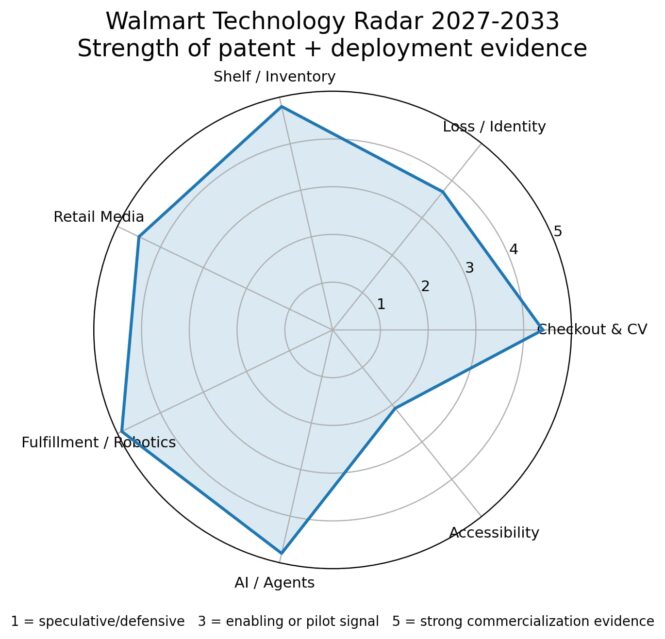
Strategic hypotheses for 2027–2033
Rather than treating these as predictions, I would prioritize the hypotheses by the strength of the underlying patent + deployment evidence.
1. The shelf becomes Walmart’s physical-store operating platform. — Strong evidence. ESLs evolve beyond price into associate guidance, picking, stocking, location and potentially media/contextual services. Walmart’s patents line up unusually well with its Vusion deployment.
2. Walmart keeps self-checkout but makes it progressively multimodal. — Strong evidence. Barcode, weight, cameras, CV, receipt reconciliation and identity validation increasingly operate as one exception-management system. The goal is likely fewer false interventions and lower shrink—not elimination of SCO.
3. Pickup/delivery fulfillment becomes much more automated behind the store. — Strong evidence. The Alert/WASR patents plus the Symbotic APD agreement make this one of the least speculative conclusions.
4. Walmart Connect increasingly reaches into the physical store. — Strong evidence for expansion; inference for individualization. The dwell-time and 2026 personalized-display filings line up closely with Walmart Connect’s growing in-store media business.
5. Sparky evolves from chatbot to transaction agent. — Evidence plus informed inference. Walmart has the recommendation/search/assistant IP and has publicly stated that Sparky is moving toward reordering, booking and multimodal interaction. Fully autonomous mission execution remains unproven.
6. Identity becomes a reusable transaction credential. — Informed inference. The long-running age-verification/biometric families support an architecture in which verified identity removes friction from restricted transactions. Broader biometric identification of ordinary Walmart shoppers should not be inferred from those patents.
7. Walmart develops a store-wide sensor fusion layer. — Informed inference, but increasingly compelling. ESL location, RFID, CV, checkout events, mobile interaction, inventory and customer data are currently represented in separate patent families. Technically, joining them creates a near-real-time digital representation of merchandise, customers and work inside the store. The portfolio points in that direction; I did not find a single patent proving Walmart has unified all of those layers.
The larger strategic picture
The most consequential finding is therefore not any single patent.
Walmart appears to be building—or preserving the IP option to build—a physical-store data plane.
The shelf knows where the merchandise belongs. Computer vision determines what is actually there. RFID helps establish identity and location. Checkout establishes what moved into a transaction. Mobile identity associates transactions with customers. Recommendation systems determine what that customer may want next. Walmart Connect monetizes the resulting audience and measurement layer. Robotics then use much of the same inventory/order data to fulfill digital demand.
That architecture would turn Walmart’s approximately 4,600 U.S. stores from comparatively static retail buildings into digitally addressable nodes for commerce + fulfillment + advertising + data + AI. The individual components are strongly supported by the patent and deployment record; the fully unified architecture is my synthesis of those components, not something Walmart has publicly confirmed.
For Kiosk Industry/TIG purposes, I think the particularly important finding is that checkout, ESL/digital shelf, computer vision and retail media should no longer be analyzed as separate Walmart technology markets. The patent record increasingly shows them converging around the transaction and the physical customer journey.