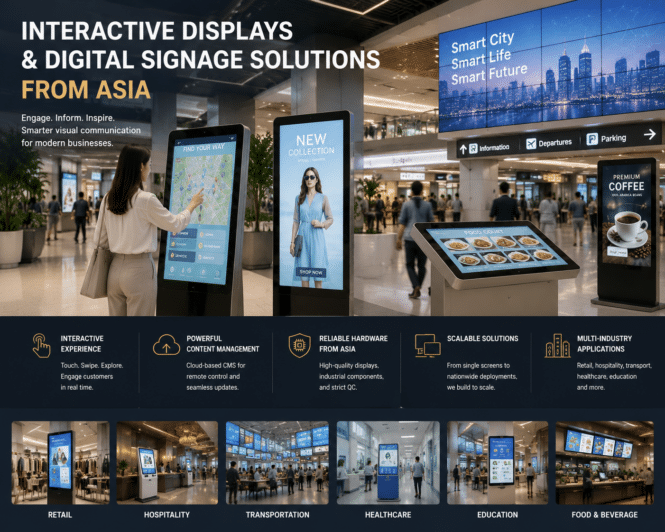
The way businesses communicate with customers is changing rapidly. Traditional advertising screens are evolving into intelligent interactive platforms that combine display technology, computing power, and software management.
Today, interactive displays are becoming a core component of modern retail stores, hotels, transportation hubs, and public facilities. By combining touch interaction, digital content, and connected systems, companies can create more engaging and efficient customer experiences.
From Digital Screens to Intelligent Interaction
Early digital signage systems were mainly designed for displaying advertisements, announcements, and basic information.
Modern interactive digital signage solutions provide a much more dynamic experience by allowing users to actively interact with content.
A complete interactive display system may include:
- Touchscreen interfaces
- Embedded computing hardware
- Cloud-based content management
- AI-powered customer analysis
- Network connectivity
This combination allows businesses to deliver personalized information and collect valuable operational insights.
Digital Signage Applications Across Industries
Smart Retail Experiences
Retail is one of the fastest-growing markets for interactive display technology.
Retailers use digital kiosk signage to improve customer engagement through:
- Product search systems
- Interactive catalogs
- Self-service ordering
- Promotional displays
- Customer navigation
These solutions help customers access information independently while allowing retailers to optimize store operations.
Hospitality and Service Industries
Hotels, restaurants, and entertainment businesses are adopting interactive solutions to improve service efficiency.
Common applications include:
- Automated hotel check-in
- Interactive restaurant menus
- Digital concierge systems
- Guest information displays
- Self-service terminals
Interactive technology helps reduce waiting times while creating a smoother customer journey.
Transportation and Public Spaces
Airports, railway stations, and government facilities rely on digital signage solutions to provide real-time information.
Typical applications include:
- Navigation systems
- Ticketing terminals
- Public announcements
- Information lookup stations
These systems improve accessibility and help organizations manage large numbers of visitors.
Building a Complete Digital Signage Solution
A professional digital signage solution requires more than a display panel.
A typical system includes several important components:
Commercial Display Hardware
Commercial-grade displays are designed for continuous operation with features such as:
- High brightness
- Long lifespan
- Durable construction
- Multiple screen sizes
Computing Hardware
The computing platform controls content playback and interactive applications.
Common options include:
- Mini PCs
- Android-based systems
- Embedded computers
- Edge AI platforms
Software Management Platform
Large-scale deployments require centralized management tools that allow operators to:
- Update content remotely
- Monitor devices
- Manage multiple locations
- Analyze user interaction
Interactive Technology
Touchscreens, cameras, and sensors enable more advanced user experiences and support intelligent applications.
Why Asian Manufacturers Are Leading the Market
Asia has become a major hub for digital signage and interactive display manufacturing due to its complete technology ecosystem.
Key advantages include:
Advanced Display Supply Chain
China, Taiwan, Japan, and South Korea have strong capabilities in:
- Display panel production
- Touch technology
- Embedded hardware
- Electronic manufacturing
Flexible OEM and ODM Services
Asian manufacturers can provide customized solutions for different industries, including:
- Interactive kiosks
- Digital signage terminals
- Smart retail displays
- Commercial touchscreens
Integrated Manufacturing Capability
From hardware components to final assembly, Asia provides a complete supply chain that helps companies develop scalable digital signage products.
Selecting the Right Interactive Display Partner
For businesses planning commercial deployments, choosing the right supplier is critical.
Important evaluation factors include:
- Display reliability
- Hardware availability
- Software compatibility
- Customization capability
- Technical support
- Long-term product lifecycle
A successful project requires not only high-quality hardware but also strong integration and service capabilities.
Future Development of Digital Signage Technology
The next generation of interactive digital signage will be influenced by emerging technologies including:
- Artificial intelligence
- Edge computing
- Computer vision
- Smart retail analytics
- Personalized content delivery
These innovations will transform digital displays from simple communication tools into intelligent customer interaction platforms.
Conclusion
Interactive displays are becoming an essential technology for modern commercial environments.
From retail stores and hospitality venues to transportation and smart cities, interactive digital signage and digital kiosk signage solutions are helping organizations improve customer engagement and operational efficiency.
With advanced manufacturing capabilities and strong OEM expertise, Asia continues to play an important role in developing the future of digital signage technology.


