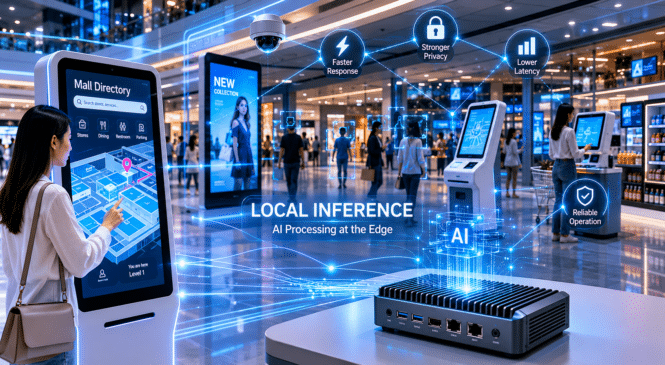
Artificial intelligence is becoming a visible part of Asia’s retail environment. From interactive kiosks and digital directories to autonomous stores and smart vending systems, AI is increasingly shaping how consumers discover products, make purchases, and interact with physical spaces.
What receives less attention is where that AI processing actually happens.
For years, cloud-based AI was assumed to be the default model. Data would be collected at the edge, transmitted to remote servers, processed in the cloud, and then returned to the device. While this approach remains valuable for large-scale analytics and centralized management, many operators are discovering that real-time customer experiences often require something different.
That is why local inference is gaining momentum across Asia’s smart mall ecosystem.
Local inference refers to AI models running directly on edge devices rather than relying entirely on cloud infrastructure. In practical terms, this means a kiosk, digital signage endpoint, mini PC, or embedded system can process AI workloads on-site without needing to send every interaction to a remote data center.
The advantages become especially clear in retail environments.
A shopper standing in front of a digital directory expects an immediate response. A computer vision system monitoring inventory needs to make decisions in real time. A self-checkout terminal cannot afford delays during a transaction. Even small amounts of latency can negatively affect customer experience.
By processing workloads locally, operators can reduce response times while improving system resilience.
Privacy considerations are also influencing architecture decisions. Across Asia, retailers operate under a variety of data protection frameworks and compliance requirements. Running inference locally allows organizations to limit how much sensitive information leaves the physical location, reducing both risk and complexity.
Cost is another factor.
Cloud AI services can become expensive when thousands of endpoints continuously transmit video streams, sensor data, and customer interactions. Local inference shifts more processing to the edge, lowering bandwidth requirements and helping operators manage long-term operating costs.
This trend is driving demand for edge AI hardware, including mini PCs, embedded systems, AI accelerators, and intelligent kiosk platforms capable of supporting modern machine-learning workloads.
The growth of smart malls throughout China, Singapore, South Korea, Japan, and Southeast Asia is accelerating this transition. These environments increasingly combine digital signage, computer vision, self-service kiosks, autonomous retail technologies, and AI-powered analytics into a unified infrastructure layer.
As deployments scale, operators are looking for architectures that balance performance, privacy, reliability, and cost efficiency.
For the self-service industry, local inference is becoming more than a technical preference. It is increasingly viewed as the foundation that enables AI experiences to operate consistently in the real world.
The next generation of smart malls may still connect to the cloud, but the intelligence driving many customer interactions will likely reside much closer to the point of service.
FAQ
What is local inference in retail AI?
Local inference refers to AI models running directly on edge devices such as kiosks, mini PCs, embedded systems, or AI cameras rather than relying entirely on cloud servers for processing.
Why is local inference important for smart malls?
It improves response times, reduces latency, strengthens privacy protection, lowers bandwidth usage, and increases operational reliability for self-service applications.
Which retail applications benefit most from local inference?
Digital directories, self-checkout systems, autonomous retail stores, computer vision analytics, smart vending machines, and AI-powered customer service kiosks.
Will cloud AI disappear from retail environments?
No. Most future deployments are expected to use hybrid architectures that combine cloud management and analytics with edge-based AI inference.
TIG Intel Insight
The rapid expansion of AI-enabled retail environments across Asia is shifting attention from AI applications to AI infrastructure. As smart malls deploy larger networks of kiosks, digital signage, computer vision systems, and autonomous retail technologies, local inference is emerging as the preferred architecture for balancing performance, privacy, scalability, and cost efficiency. Organizations that invest in edge AI capabilities today will be better positioned to support the next generation of intelligent self-service experiences.
Resources
- What Intel vPro Means for Large Kiosk Fleets in Asia
- Cash Is Still King in Asia
- China’s Retail Robotics Layer
- China’s Autonomous Parking and EV Charging Infrastructure
- Giada: Edge AI & Media Player Solutions
- Smart Vending Machines Becoming AI Retail Platforms
- Self-Service Government Terminals in China
- Shopping Malls: The Future of Retail in China


