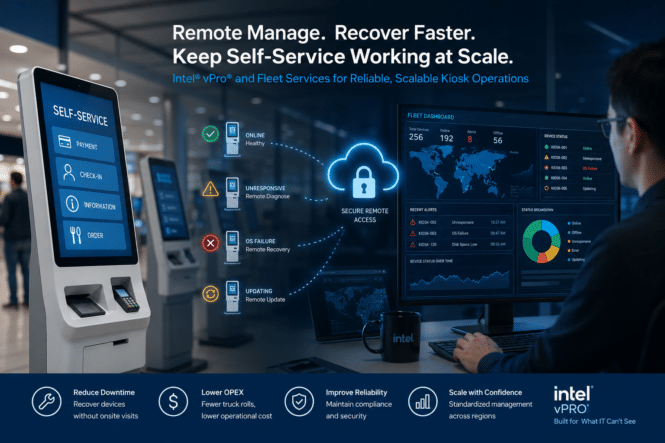
What Intel vPro Means for Large Kiosk Fleets in Asia

By | May 28, 2026
Kiosk Management,

Fleet Management Becomes a Core Self-Service Issue

Fleet management is not the most visible part of self-service, but it is often the part that determines whether a deployment actually works at scale.

A kiosk can look impressive on the show floor and still become a service headache once it is deployed across dozens or hundreds of sites. That is why hardware-based remote management deserves more attention in Asia’s expanding self-service market.

Intel vPro is important in this discussion because it is built around out-of-band manageability and remote access that can continue to function even when the operating system is unresponsive. In plain terms, that gives operators and IT teams a way to reach, diagnose, and in some cases recover systems without sending a technician onsite for every incident.

That capability becomes especially relevant in Asia, where self-service fleets may be spread across dense urban retail chains, hospital networks, bank branches, transit environments, and franchise operations.

Why Remote Recovery Matters at Scale

The larger and more distributed the estate becomes, the more expensive truck rolls, delayed fixes, and inconsistent support processes become.

Intel’s current Fleet Services positioning is aimed at simplifying activation and management while preserving hardware-level access to supported devices. The practical appeal is not abstract. If a self-service endpoint freezes, fails to boot properly, or becomes inaccessible through normal software tools, a remote management path can materially reduce downtime.

For kiosk operators, that is a business issue as much as a technical one. Downtime affects transaction volume, queue management, customer trust, and labor allocation, especially in unattended or lightly staffed environments.In markets where device fleets are growing faster than onsite support teams, remote manageability becomes part of the rollout economics from day one.

Beyond Enterprise PCs: vPro in Self-Service Infrastructure

This is also where Intel vPro fits into a larger self-service infrastructure conversation rather than just an enterprise PC discussion. Many kiosk and self-service endpoints share the same need for lifecycle control, patching, visibility, and secure recovery, even if they sit inside purpose-built enclosures and run specialized applications. The kiosk world has sometimes treated those needs as secondary to enclosure design and user interface, but once fleets mature, support discipline becomes central.

The Asia Deployment Challenge

The Asia angle matters because regional deployments often involve variation across language, payment behavior, connectivity conditions, and service partners.A remote management framework does not erase those differences, but it does give operators a more standardized way to control and recover their endpoint base.That helps reduce the complexity that naturally comes with multi-market growth.

There is also a credibility issue here.Too many edge and AI stories talk about what devices can do when everything works perfectly. vPro is more relevant because it addresses what happens when systems fail, stall, or drift out of compliance. In self-service, that is often the dividing line between a pilot and a sustainable deployment.

For KioskAsia, the stronger editorial framing is not “Intel has management technology.” It is that the next stage of Asian self-service growth depends on infrastructure that can be seen, serviced, and recovered at scale.When fleets get bigger, remote control is no longer an IT bonus. It becomes part of the business model.


TIG Intel Insight: vPro for Kiosk Fleets

By: Craig Allen Keefner

Extract: Intel vPro matters to self-service when it reduces truck rolls, shortens downtime, and gives operators a hardware-level path to recover distributed endpoints.

Field basis: I follow unattended deployments where the real challenge is not launching a kiosk but keeping a large installed base available, patched, and supportable over time.

Commentary: The self-service business has a habit of overvaluing the customer-facing layer and undervaluing the support layer. That is backwards once fleets become large. Hardware-level remote management is one of the clearest dividing lines between a promising pilot and a durable operating model. Intel’s value here is straightforward: when a system is no longer behaving normally, operators still need a path to reach it. In the field, that is not a feature. It is survival.

Topics: Intel vPro, fleet services, kiosk fleet management, AMT, remote recovery, unattended endpoints, APAC operations.


FAQ block

What is Intel vPro Fleet Services?

Intel describes vPro Fleet Services as a hosted management approach built on Intel Active Management Technology that simplifies remote management of supported Intel vPro devices.

Why does it matter for kiosks?

It matters because hardware-level remote access can help operators reach and recover devices even when the operating system is not responding normally.

Why is this useful in Asia?

Asia’s self-service growth often means distributed fleets across many sites and partner environments, which increases the value of remote remediation and standardized support processes.

Is this only an IT story?

No, for kiosk fleets it is also an operations and cost story because faster recovery can reduce downtime, onsite service calls, and lost transactions.