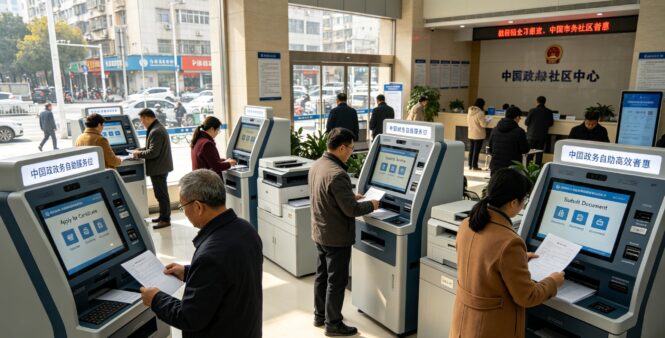
China has built one of the world’s most extensive networks of self-service government terminals, transforming how public services are delivered at scale.
These kiosks enable citizens to complete tasks such as identity verification, document processing, and payments without interacting with staff—turning government services into a distributed, always-on digital infrastructure.
According to the United Nations E-Government Survey 2022, China ranks among global leaders in digital public service delivery, reflecting the scale and maturity of its digital infrastructure.
However, as deployment accelerates, a new question is emerging:
How do we balance efficiency with accessibility in fully automated public services?
From Service Counters to Distributed Infrastructure
Traditionally, government services have relied on physical offices and manual workflows.
China is rapidly moving beyond this model. Today, self-service government kiosks are widely deployed across cities and communities, supporting services such as:
- Identity verification (often via biometrics)
- Document issuance and printing
- Social security and tax services
- Administrative payments
The World Bank has highlighted China’s “One-Stop / One-Network Government Service” initiatives as a way to address the “last mile” challenge in public service delivery.
This reflects a structural shift:
Public services are no longer locations—they are infrastructure.
Why the Self-Service Government Model Scales
China’s ability to deploy government kiosks at scale is driven by system-level integration rather than standalone devices.
Unified Digital Platforms
Kiosks are connected to centralized platforms that enable:
- Cross-department data sharing
- Real-time processing
- Standardized service delivery
Research from McKinsey & Company highlights that China’s digital transformation is increasingly based on integrated, end-to-end infrastructure, rather than isolated digital tools.
Integrated Identity Systems
Digital identity systems, including biometric verification, allow secure and automated transactions.
This reduces friction and enables high-frequency service usage without manual intervention.
Public-Private Collaboration
Major technology providers such as Huawei, Alibaba, and Tencent play a key role in delivering:
- Cloud infrastructure
- Hardware systems
- Platform integration
This collaboration accelerates deployment and ensures scalability.
Operational Impact
From an industry perspective, self-service government terminals deliver measurable efficiency gains.
Efficiency and Throughput
- Reduced waiting times
- Faster transaction cycles
- Standardized service delivery
China’s broader digital economy, which contributes significantly to national productivity growth (as noted by McKinsey Global Institute), provides the foundation for these improvements.
Cost and Labor Optimization
- Reduced reliance on front-desk personnel
- Lower operational costs
- Improved scalability across regions
24/7 Service Availability
- Continuous service access
- Increased service capacity without expanding physical offices
The Emerging Challenge: Accessibility
Despite these benefits, large-scale automation introduces new challenges.
China’s population aged 60 and above has exceeded 320 million, according to official demographic data. This creates a significant user group that may face barriers in digital environments.
Studies on digital adoption and public services (including academic research on smart cities and e-government systems) suggest that:
- Digital literacy varies significantly across demographics
- Interface complexity directly impacts usability
- Biometric and mobile-first systems can exclude certain users
This leads to a critical tension:
Systems optimized for efficiency may unintentionally reduce accessibility.
Designing the Next Generation of Self-Service Government
The industry is now shifting toward inclusive and user-centered design.
Hybrid Service Models
Rather than replacing traditional channels entirely, successful systems combine:
- Mobile platforms
- Self-service kiosks
- On-site human assistance
Inclusive Interface Design
Next-generation kiosks are incorporating:
- Larger text and simplified UI
- Voice-guided interaction
- Linear, step-by-step workflows
Research in human-computer interaction and smart retail systems shows that multi-device coordination and simplified interfaces are critical to adoption.
Human-in-the-Loop Support
Service centers are evolving into digital support hubs, where staff assist users in navigating automated systems.
This reflects a hybrid model:
Automation supported by human guidance
Global Implications
China’s experience offers important lessons for global markets.
Compared with other regions:
- China emphasizes scale and infrastructure integration
- Europe and the U.S. emphasize regulation and accessibility compliance
Frameworks such as the Americans with Disabilities Act highlight the importance of inclusive design in public systems.
Government Self-Service Conclusion
China’s self-service government terminals demonstrate how public services can be transformed into automated, scalable infrastructure.
But the next phase of development will depend on more than efficiency.
Long-term success will require balancing scale with accessibility, and automation with human-centered design.
- China’s Smart Cinemas: Ticketing Terminals and AI Advertising
- Healthcare in Shanghai – Kiosks and AI
- China’s QR Code Economy Built the Perfect Environment for Self-Service
- The “Screen Economy”: Why China Deploys More Digital Signage Than Any Market
- Interactive Digital Software by Sitekiosk
- Facial Recognition Buyer’s Guide and Executive Checklist
- Intel Core Ultra Series 3 with Intel vPro
- NRA National Restaurant Show
- CareU service simulates everyday kiosk environments to help seniors gain confidence
- 2026 Strategic Compliance Checklist