The Perfect Environment for Self-Service
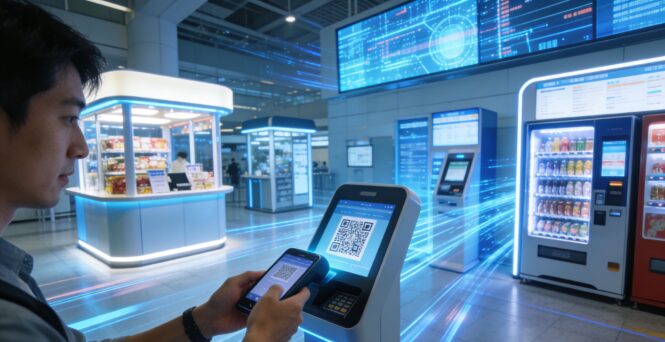
China has built the world’s most scalable self-service ecosystem—not because of superior hardware, but because of a frictionless QR code payment infrastructure led by Alipay and WeChat.
With QR payments deeply embedded into daily behavior, China has removed the biggest constraint in kiosk deployment: payment integration complexity.
The result is a high-growth, high-density self-service market that continues to outpace Western markets in speed, cost efficiency, and scalability.
Payments + Self-Service Convergence
QR Code Payment Market (China)
- 2024 market size: $692.5M
- 2033 forecast: $3.4B
- CAGR (2025–2033): 20%Grandview
Globally, QR payments are scaling rapidly, expected to grow from $12.5B (2024) to $61.7B (2033), with Asia-Pacific—led by China—holding the largest shareGrandview
Self-Service Kiosk Market (China)
- 2024 market size: $3.03B
- 2030 forecast: $6.37B
- CAGR (2025–2030): 13.6%Grandview
China is already:
- The largest self-service kiosk market in Asia-Pacific
- Among the fastest-growing globallyGrandview
Core Insight: Payment Infrastructure = Deployment Speed
In Western markets, self-service deployment is constrained by:
- EMV certification cycles
- POS hardware costs
- Banking integrations
- PCI compliance
In China, QR payments eliminate all of the above.
Deployment Equation in China:
Display + QR Code + Mobile Wallet = Payment-enabled kiosk
This fundamentally changes the economics of self-service:
| Factor | Western Model | China Model |
| Payment hardware | Required | Not required |
| Integration time | Weeks–months | Days |
| Cost per kiosk | High | Low |
| Maintenance | Hardware-dependent | Software-driven |
Why China Scales Faster
1. Hardware Abstraction via QR Codes
QR codes turn payment into a software layer, not a hardware dependency.
- No NFC readers required
- No card terminals
- No banking device approvals
This enables:
- Rapid rollout of vending machines
- Pop-up retail automation
- Low-cost experimentation
2. Super-App Ecosystem Effects
WeChat and Alipay function as infrastructure platforms, not just wallets.
They integrate:
- Identity (real-name systems)
- Payments
- Mini-programs (service layer)
- Loyalty & CRM
This allows kiosks to become:
Nodes inside a broader digital ecosystem—not standalone endpoints
Example:
- Scan QR → open mini-program → order → pay → receive → re-engage
3. Behavioral Standardization at Scale
China’s advantage is not just technology—but user habit uniformity:
- QR scanning is universal behavior
- Cash usage is minimal in urban environments
- Even micro-merchants accept QR payments
This leads to:
- Near-zero onboarding friction
- High conversion rates on kiosks
- Faster adoption of new formats
4. Cost Structure Enables Over-Deployment
Lower deployment cost = higher density.
Because QR-based kiosks:
- Require less upfront investment
- Have fewer failure points
- Are easier to maintain
Operators can:
- Deploy more machines per location
- Test more formats (retail, healthcare, transit)
- Iterate faster
This explains why China leads in:
- Smart vending density
- Unmanned retail pilots
- Self-service healthcare and government terminals
5. Payment as a Growth Multiplier
QR payments are not just a feature—they are a growth multiplier:
- Faster checkout → higher throughput
- Lower friction → higher usage frequency
- Integrated ecosystem → higher lifetime value
Globally, QR payments are growing at ~20% CAGR, largely driven by their low cost and ease of adoptionRISE
Strategic Implications for Industry Players
For Kiosk Manufacturers
- China proves that payment simplification drives hardware scale
- Future competitiveness depends on:
- Software integration
- Cloud connectivity
- Ecosystem compatibility
For Operators
- Payment friction directly impacts ROI
- Markets with fragmented payment systems will face:
- Slower rollout
- Higher customer drop-off
- Increased operational complexity
For Western Markets
To replicate China’s growth trajectory, key gaps must be addressed:
- Fragmented payment systems (cards, wallets, apps)
- Lack of universal QR adoption
- Higher compliance and infrastructure costs
Until then, self-service growth will remain:
Capital-intensive, slower, and less scalable
Conclusion
China’s leadership in self-service is not driven by AI, robotics, or hardware innovation alone.
It is driven by a simple but powerful shift:
Turning payment into a low-cost, universal, software-defined layer
Through QR code payments powered by Alipay and WeChat, China has created:
- The lowest-friction payment environment globally
- The fastest deployment cycle for kiosks
- The most scalable self-service ecosystem
For B2B players, the takeaway is clear:
Whoever controls the payment layer controls the speed of self-service adoption.
More Resources
- The “Screen Economy”: Why China Deploys More Digital Signage Than Any Market
- Interactive Digital Software by Sitekiosk
- Facial Recognition Buyer’s Guide and Executive Checklist
- Intel Core Ultra Series 3 with Intel vPro
- NRA National Restaurant Show
- CareU service simulates everyday kiosk environments to help seniors gain confidence
- 2026 Strategic Compliance Checklist
- Interactive Software and Interactive Hardware
- Coffee by Drone and AI Scan Checkout – Shenzhen
- Why are Digital Screens So Widespread in China
- Interactive Digital Software by Sitekiosk
- Facial Recognition Kiosk Hardware: A Buyer’s Guide and Executive Checklist
- Intel Core Ultra Series 3 with Intel vPro
- NRA National Restaurant Show
- 2026 Strategic Compliance Checklist
- EAA Checklist for 2026
- CareU service simulates everyday kiosk environments to help seniors gain confidence
- Raspberry Pi Digital Signage Software Released

