For years, the global banking industry predicted a fully cashless future.
Mobile wallets, QR-code payments, digital banks, and real-time transfers were expected to gradually reduce the need for physical cash infrastructure.
But across Asia, the reality looks very different.
Even as digital payments continue to grow rapidly, cash remains deeply embedded in daily life across many Asian economies. Instead of removing cash infrastructure, banks are increasingly modernizing it through self-service kiosks, smart cash systems, and retail-based banking networks.
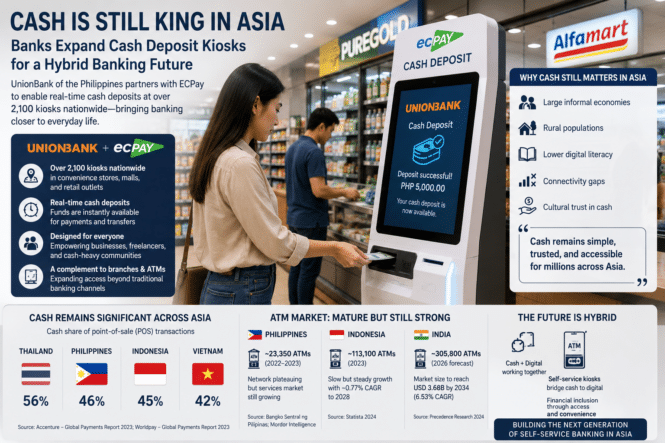
A recent example comes from UnionBank, which partnered with ECPay to enable real-time cash deposits at more than 2,100 kiosks nationwide. According to the report, the kiosks are located across convenience stores, malls, groceries, and community retail locations throughout the Philippines.
The move highlights a larger trend across Asia:
The future of banking in many Asian markets is not “cashless.”
It is hybrid banking — where physical cash and digital finance coexist.
Table of Contents
ToggleUnionBank Expands Cash Access Through Retail Kiosks
Under the partnership, UnionBank customers can deposit cash instantly through ECPay kiosks without visiting traditional branches or ATMs. Deposits are processed in real time, allowing customers to immediately use funds for digital payments, online shopping, and mobile banking.
The system mainly targets:
- Small business owners
- Freelancers
- Cash-heavy workers
- Underbanked communities
- Rural consumers
For many users, cash still represents their main source of income and daily transactions, even if they also use digital banking apps.
Rather than forcing customers into a fully digital system, UnionBank is building a bridge between physical cash and digital finance.
Why Cash Still Matters Across Asia
Asia is often viewed as one of the world’s fastest-growing digital payment regions.
Countries such as China, Singapore, and India have become global leaders in mobile payments and fintech adoption.
However, cash remains highly important across many parts of Asia.
Recent payment data shows that cash still accounts for a large share of point-of-sale transactions in several Southeast Asian markets:
- Thailand: approximately 56%
- Philippines: approximately 46%
- Indonesia: approximately 45%
- Vietnam: approximately 42%
These figures are based on regional payment industry reports covering cash usage in Asia-Pacific retail transactions.
Even in advanced economies, cash usage remains surprisingly strong.
In Japan, around half of point-of-sale payments are still made in cash. Taiwan and Singapore also continue to maintain significant cash usage despite strong digital payment infrastructure.
This reflects several long-term factors:
- Large informal economies
- Rural populations
- Aging demographics
- Lower digital literacy
- Connectivity gaps
- Cultural trust in physical money
For millions of consumers, cash remains simple, trusted, and accessible.
Cash Infrastructure Is Evolving, Not Disappearing
The growth of digital banking does not necessarily mean the end of cash infrastructure.
Instead, banks are redesigning how cash moves into digital systems.
This is where self-service kiosks are becoming increasingly important.
Rather than building expensive new branches, financial institutions are increasingly using:
- Retail kiosks
- Convenience stores
- Agent banking networks
- Smart ATMs
- Cash recyclers
- Third-party payment terminals
to create distributed banking access points.
In effect, retail locations are becoming micro-banking hubs.
The UnionBank-ECPay partnership reflects this shift clearly.
Instead of expanding only through branches and ATMs, UnionBank is extending banking services into everyday retail environments where consumers already shop and pay bills.
The ATM Industry Is Not Declining as Fast as Expected
Despite rapid digital payment growth, ATM infrastructure across many Asian markets remains relatively stable.
In the Philippines, ATM growth has slowed, but the network remains important for daily banking access. Industry reports show the country’s ATM managed services market continues to grow as banks modernize hardware, software, and security systems.
Indonesia’s ATM network is also still expanding slowly, supported by financial inclusion programs and continued cash demand.
India remains one of the strongest ATM growth markets globally. Industry forecasts estimate India’s ATM market could grow from approximately USD 1.94 billion in 2025 to USD 3.68 billion by 2034.
Growth is supported by:
- High cash circulation
- Government banking programs
- Rural banking demand
- Financial inclusion initiatives
At the same time, banks are increasingly investing in smarter ATM systems and alternative cash-access channels rather than traditional branch expansion.
This includes:
- Cash deposit kiosks
- Smart recycling ATMs
- Retail banking terminals
- Self-service banking machines
The result is not the disappearance of cash infrastructure — but its modernization.
Self-Service Banking Is Expanding Beyond Traditional ATMs
One of the biggest changes in Asia’s banking industry is the shift from centralized banking infrastructure toward distributed self-service finance.
Historically, cash services depended heavily on:
- Bank branches
- Traditional ATMs
- Centralized banking locations
Today, banks are increasingly embedding financial services into retail environments.
Convenience stores, supermarkets, pharmacies, and shopping malls are becoming part of the banking ecosystem itself.
This trend is especially important in emerging Asian markets where:
- Branch access may be limited
- Banking penetration remains uneven
- Consumers still rely heavily on cash
Self-service kiosks help solve these gaps while supporting digital banking adoption at the same time.
Hybrid Banking May Define Asia’s Financial Future
Asia’s banking future may not be fully digital or fully cash-based.
Instead, the region is moving toward hybrid financial infrastructure where physical cash and digital systems operate together.
Consumers increasingly expect:
- Instant digital payments
- Mobile banking convenience
- Real-time transfers
But many still earn, save, and transact using cash.
This creates demand for systems that can easily connect physical money with digital finance.
Cash deposit kiosks, smart ATMs, and retail banking terminals are becoming key parts of this transition.
For banks, fintech firms, ATM providers, and kiosk companies, this shift creates a major opportunity:
Building the next generation of self-service financial infrastructure for Asia’s hybrid payment economy.
More information
- China’s Retail Robotics Layer: How Service Robots Are Becoming Part of Store Infrastructure
- China’s Autonomous Parking and EV Charging Infrastructure: Building the Foundation of Self-Service Urban Mobility Systems
- Giada: Edge AI & Media Player Solutions
- Smart Vending Machines Becoming AI Retail Platforms
- Self-Service Government Terminals in China
- Shopping Malls: The Future of Retail in China
- China’s Smart Cinemas: Ticketing Terminals and AI Advertising
- Healthcare in Shanghai – Kiosks and AI
- China’s QR Code Economy for Self-Service
- Interactive Software and Interactive Hardware