Building the Foundation of Self-Service Urban Mobility Systems
From KioskAsia — China’s urban mobility landscape is undergoing a structural transformation. What was once a fragmented system of parking facilities, EV charging stations, and traffic management infrastructure is rapidly evolving into an integrated, self-service mobility ecosystem.
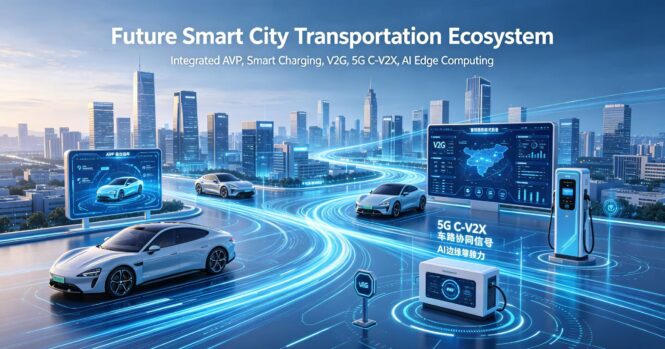
At the core of this transformation is the convergence of autonomous parking (AVP), EV charging infrastructure, V2G energy systems, and AI-driven urban mobility platforms.
By 2025, China has established itself as the world’s largest EV charging market, with over 20 million charging facilities nationwide, including approximately 4.7 million public chargers and more than 15 million private units, reflecting an unprecedented level of infrastructure penetration in urban environments.Xinhua
This scale is not only quantitative—it is structural. It is reshaping how vehicles interact with cities, energy systems, and digital infrastructure.
1. The Infrastructure Backbone: Scale and Market Expansion
China’s EV charging infrastructure represents one of the fastest-growing physical-digital infrastructure systems globally.
According to industry estimates, the market size of EV charging infrastructure in China is expected to reach USD 37.6 billion by 2026, with a projected compound annual growth rate (CAGR) of approximately 46.9% through 2031.Data
At the policy level, China is targeting a 2:1 vehicle-to-charger ratio by 2025, with a long-term ambition of approaching a 1:1 equilibrium by 2030, signaling a transition from supply-constrained infrastructure to demand-balanced deployment.
This expansion is supported by a multi-layered deployment strategy:
- Urban fast-charging networks
- Highway corridor charging systems
- Residential and community-based charging integration
The result is not simply infrastructure expansion, but the creation of a nationwide distributed energy access network for mobility systems.
2. Autonomous Valet Parking (AVP): The Emergence of Machine-Orchestrated Parking Systems
One of the most significant shifts in urban mobility is the rise of Autonomous Valet Parking (AVP) systems.
AVP enables vehicles to self-navigate into parking structures without human intervention, leveraging:
- Low-speed autonomous driving (L2+ to L4 transition)
- AI-based spatial recognition
- Infrastructure-assisted localization systems
Asia-Pacific, particularly China, is currently the fastest-growing region for AVP deployment and testing environments. Market projections estimate AVP-related systems to reach approximately USD 460 million by 2026, driven by increasing demand for automated parking solutions in dense urban environments.
In advanced deployments, AVP systems are increasingly integrated with charging infrastructure, enabling a continuous flow:
Vehicle arrival → autonomous parking → automated charging → digital payment → autonomous exit
This creates a closed-loop mobility service model, reducing human dependency in parking operations.
3. EV Charging Meets Energy Systems: The Rise of V2G Integration
Beyond charging infrastructure, China is actively advancing Vehicle-to-Grid (V2G) systems, positioning EVs as distributed energy assets rather than passive consumers.
Pilot programs have been approved in approximately nine cities across China, involving over 30 V2G demonstration projects.
The long-term objective is to establish a standardized V2G ecosystem by 2030, enabling:
- Grid load balancing through EV batteries
- Peak shaving and demand response optimization
- Integration of renewable energy sources into mobility systems
Research indicates that EV charging infrastructure is increasingly being repositioned as part of the smart grid architecture, rather than standalone transportation support systems.
This shift introduces a new layer of complexity:
Charging infrastructure becomes part of national energy management systems.
4. Automation Layer: Charging Robotics and C-V2X Integration
China is also exploring the integration of robotic charging systems and C-V2X (Cellular Vehicle-to-Everything) communication technologies, which enable end-to-end automation in mobility environments.
Key developments include:
- Automated charging robots capable of physical plug-in operations
- High penetration of C-V2X-enabled vehicles (targeting ~50% of new vehicles in 2025)
- Integration of 5G-enabled infrastructure for real-time vehicle coordination
This enables a fully automated sequence:
autonomous parking → robotic charging → automated billing → vehicle retrieval
Such systems represent the early formation of what can be described as machine-orchestrated urban mobility infrastructure.
5. Case Studies: Industrial Ecosystem Development
China’s autonomous mobility ecosystem is supported by several key industrial players:
Baidu Apollo
Baidu’s Apollo platform has deployed large-scale autonomous driving and Robotaxi operations across multiple cities, integrating AI mobility services with urban infrastructure.
WeRide
WeRide has demonstrated significant revenue growth driven by L4 autonomous vehicle deployment and mobility data services, highlighting commercial viability beyond pilot testing phases.
These companies illustrate the transition from experimental autonomous systems to commercial urban mobility operations.
6. Strategic Challenges for Global Stakeholders
Despite rapid advancement, several structural challenges remain relevant for international stakeholders:
1. Standardization and Interoperability
Differences between China’s GB/T charging standards and international CCS2 systems create integration barriers for global OEMs and infrastructure providers.
2. Monetization Model Evolution
The revenue structure of EV infrastructure is shifting:
- From static charging fees
- To dynamic pricing models including:
- grid balancing incentives
- parking premium services
- energy arbitrage mechanisms
3. System Complexity
Integration of AVP, V2G, and C-V2X introduces significant system complexity requiring coordination between automotive, energy, and telecommunications sectors.
Conclusion: Toward a Unified Self-Service Mobility Ecosystem
China’s approach to autonomous parking and EV charging infrastructure represents a broader shift from traditional transportation infrastructure toward integrated, self-operating urban mobility systems.
The convergence of:
- autonomous parking systems
- intelligent charging networks
- vehicle-grid integration
- robotic service automation
is creating a foundational model where vehicles are no longer simply transported objects, but active participants in a machine-coordinated urban energy and mobility network.
For global stakeholders—including OEMs, energy companies, and smart city integrators—this transformation signals both a technological benchmark and a potential blueprint for future urban mobility systems.
More information
- Giada: Edge AI & Media Player Solutions
- Smart Vending Machines Becoming AI Retail Platforms
- Self-Service Government Terminals in China
- Shopping Malls: The Future of Retail in China
- China’s Smart Cinemas: Ticketing Terminals and AI Advertising
- Healthcare in Shanghai – Kiosks and AI
- China’s QR Code Economy for Self-Service
- Interactive Software and Interactive Hardware
- Coffee by Drone and AI Scan Checkout – Shenzhen
- Why are Digital Screens So Widespread in China
- Interactive Digital Software by Sitekiosk
- Facial Recognition Kiosk Hardware: A Buyer’s Guide and Executive Checklist
- Intel Core Ultra Series 3 with Intel vPro
- NRA National Restaurant Show
- 2026 Strategic Compliance Checklist