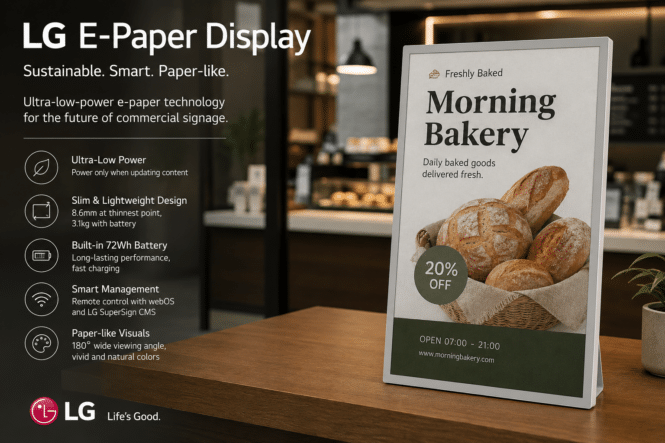
LG Electronics Launches Ultra-Low-Power “LG E-Paper Display” for Commercial Spaces
The commercial signage industry has spent years balancing two competing priorities: delivering dynamic content while reducing energy consumption.
LG Electronics believes electronic paper technology may help solve that challenge.
The company recently introduced its new LG E-Paper Display, an ultra-low-power commercial display solution designed for retail stores, hospitality venues, corporate environments, and other indoor public spaces. The product combines the flexibility of digital content management with the visual characteristics of traditional printed posters.
At a time when businesses are under increasing pressure to reduce operating costs and improve sustainability, the launch highlights a growing industry shift toward alternative display technologies that consume significantly less power than conventional LCD signage.
A Different Approach to Commercial Displays
Unlike traditional digital signage, the LG E-Paper Display uses electronic ink technology. Images are created by electrically positioning colored particles on the display surface, allowing content to remain visible without continuous power consumption.
Power is only required when content is updated.
This approach dramatically reduces energy usage compared with conventional displays that require constant backlighting and active operation throughout the day.
The display features a 32-inch QHD panel with a resolution of 2,560 × 1,440 and a standard 16:9 aspect ratio, making it suitable for promotional content, informational signage, menu boards, corporate communications, and retail advertising.
Bridging Print and Digital
One of the most interesting aspects of electronic paper technology is its ability to mimic the appearance of printed media.
The LG E-Paper Display offers a paper-like visual experience without requiring a backlight. This reflective display design helps create a natural viewing experience while reducing visual fatigue often associated with illuminated screens.
For retailers and hospitality operators, this creates opportunities to replace printed posters with digital alternatives while maintaining a familiar aesthetic.
The display also supports wide 180-degree viewing angles and utilizes LG’s image optimization technology to improve color reproduction, helping deliver more vivid and natural-looking content.
Designed for Flexible Deployment
Physical design remains an important consideration for commercial signage deployments.
LG’s new display measures only 17.8 millimeters thick overall and reaches just 8.6 millimeters at its thinnest point. Weighing approximately 3.1 kilograms, including the battery, the unit can be installed and repositioned with relative ease.
These characteristics make the solution suitable for environments where traditional digital signage may be impractical due to power availability, installation constraints, or aesthetic requirements.
Potential deployment scenarios include:
- Retail promotional displays
- Shelf-edge communication
- Hotel information boards
- Corporate announcements
- Shopping mall directories
- Temporary event signage
- Pop-up retail environments
Battery-Powered Operation and Energy Efficiency
Energy efficiency is arguably the display’s most significant differentiator.
The unit incorporates a 72Wh battery and an ultra-low-power system-on-chip architecture designed specifically for extended operation.
Because the display consumes power primarily during content refreshes, charging frequency can be significantly reduced depending on usage patterns.
LG has also implemented intelligent power management capabilities that automatically activate the display when content updates are scheduled. This helps organizations further minimize unnecessary power consumption while maintaining operational flexibility.
As sustainability initiatives become increasingly important across retail and commercial real estate sectors, technologies that reduce both energy use and paper waste are likely to attract growing interest.
Remote Management for Enterprise Deployments
Hardware innovation alone is rarely enough in modern signage environments.
The LG E-Paper Display runs a signage-focused version of webOS and includes integrated Wi-Fi connectivity, enabling remote monitoring and administration.
Users can manage device settings, monitor operational status, deploy software updates, and replace content through browser-based management tools.
Integration with LG SuperSign CMS further expands deployment possibilities by allowing organizations to distribute and schedule content across multiple displays simultaneously.
This centralized management capability is particularly valuable for enterprise customers operating large networks of displays across multiple locations.
What This Means for the Digital Signage Industry
The introduction of the LG E-Paper Display reflects broader trends reshaping the digital signage market.
Businesses increasingly want solutions that combine:
- Lower energy consumption
- Reduced maintenance requirements
- Simplified content management
- Sustainability benefits
- Flexible deployment options
Traditional LCD and LED signage will continue to dominate applications requiring video, animation, and real-time content updates. However, electronic paper displays are emerging as a compelling alternative for static or infrequently updated content.
For retailers, hospitality operators, and corporate facilities managers, the technology offers a potential middle ground between printed signage and always-on digital displays.
As organizations continue seeking ways to reduce operational costs and meet sustainability targets, ultra-low-power display technologies such as LG’s E-Paper Display may become an increasingly important component of future commercial communication strategies.
Industry Takeaway
The LG E-Paper Display is more than just another signage product launch. It represents a growing movement toward sustainable digital infrastructure, where content flexibility no longer requires continuous power consumption.
For businesses evaluating next-generation signage solutions, electronic paper technology is moving beyond niche applications and becoming a practical option for large-scale commercial deployments.
Resources
- Hybrid Self-Service in Asia: Cash, QR and AI
- Why Local Inference Is Winning in Asia’s Smart Malls
- What Intel vPro Means for Large Kiosk Fleets in Asia
- Cash Is Still King in Asia
- China’s Retail Robotics Layer
- China’s Autonomous Parking and EV Charging Infrastructure
- Giada: Edge AI & Media Player Solutions
- Smart Vending Machines Becoming AI Retail Platforms
- Self-Service Government Terminals in China