Summary: Smart Lockers as Urban Infrastructure—Lessons from China
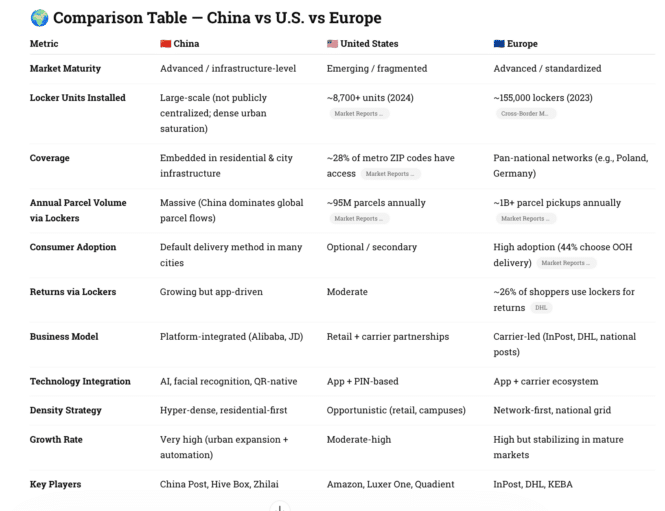
In China’s high-density cities, door-to-door delivery is increasingly inefficient. Smart lockers have emerged as a 24/7 self-service solution, with networks like Hive Box operating over one million units to manage the country’s 130 billion annual parcels.
Reference – How Are Smart Lockers Transforming Last-Meter Logistics in China in 2026?
Why the China Model is Winning:
-
Infrastructure Status: In Tier 1 and 2 cities, lockers are now considered essential utilities, similar to elevators or mailrooms, integrated directly into residential compounds and transit hubs.
-
Cost Efficiency: Implementing these systems reduces logistics labor costs by 10–20% and slashes failed delivery attempts by up to 25%.
-
The Technology Stack: These aren’t just boxes; they are sophisticated kiosks utilizing IoT monitoring, cloud management, and “mobile-first” QR/facial recognition access.
Expanding Beyond Parcels: The market is shifting toward specialized, multi-purpose hardware. Refrigerated modules for fresh groceries, meals, and pharmaceuticals are seeing 15–20% higher utilization rates than parcel-only systems.
Strategic Takeaways for the Self-Service Industry:
-
Manufacturing Dominance: China’s control over key components—display panels, embedded PCs (often powered by Intel), and IoT sensors—positions its OEMs (like Zhilai Tech) as dominant global suppliers.
-
Market Divergence: While China follows an “Infrastructure Model” and Europe a “Network Model,” the U.S. remains a “Fragmented/Opportunity Model” with significant upside in multi-family housing and BOPIS (Buy Online, Pick Up In-Store) retail.
-
The “Smart Tip”: Hardware costs vary wildly by region. A standard master/slave setup can cost ~$1,800 in emerging markets compared to ~$3,500 in the U.S. or Europe, impacting how quickly these networks can scale.
The Bottom Line: As urban centers worldwide face growing delivery congestion, the integration of modular hardware and digital authentication seen in China is becoming the global standard for last-mile logistics.
Related
- $200 AI Retrofit Compare to China’s AI-Native Smart Terminals
Summary — $200 AI Retrofit vs. China’s AI-Native Smart Terminals Read full article 1. The $200 AI Retrofit Model This approach upgrades existing …
- China’s 15th Five-Year Plan Accelerate Tech Self-Reliance
Summary — China’s 15th Five-Year Plan and Hardware Self-Reliance (2026–2030) China’s 15th Five-Year Plan (2026–2030) signals a major shift toward technological …
- The “Digital Divide” Paradox: When Healthcare Automation Becomes the Barrier
Designing Kiosks To Be Inclusive Efficiency vs. Empathy: A Decade of Rapid Digitization For ten years, the global healthcare mission has been …
- Acer Repositions With Posiflex Buy
Implications for Posiflex Group (Posiflex, Portwell, KIS) TAIPEI (February 21, 2025), Acer Inc. (TWSE: 2353) announced plans to acquire 25.6% of …
