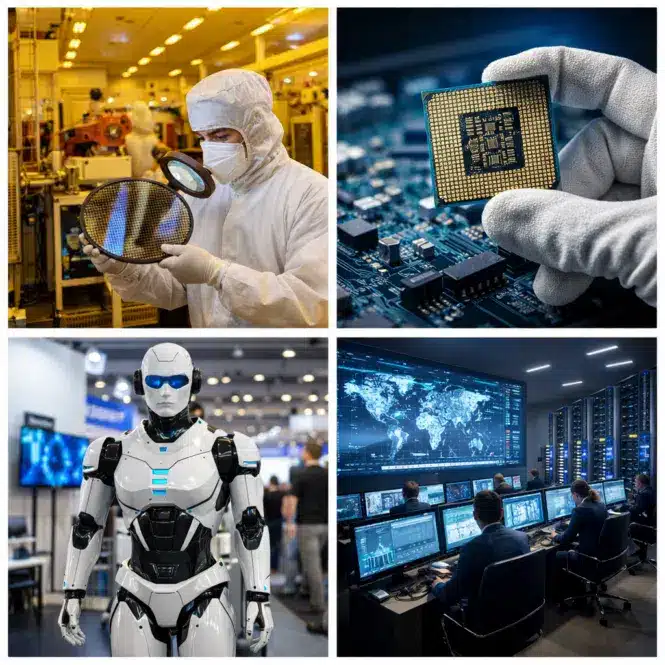
Summary — China’s 15th Five-Year Plan and Hardware Self-Reliance (2026–2030)
China’s 15th Five-Year Plan (2026–2030) signals a major shift toward technological self-reliance and industrial independence, especially in hardware sectors such as semiconductors, AI accelerators, robotics, and advanced manufacturing. The strategy reflects Beijing’s response to geopolitical tensions and export controls on advanced technologies, particularly from the United States.
Key Themes
1. Technology Sovereignty as National Policy
The plan elevates homegrown “core technologies”—including chips, AI infrastructure, and advanced materials—to strategic priority. The government aims to reduce dependence on foreign suppliers and ensure domestic control over critical components and manufacturing capabilities.
2. Industrial Upgrading and Manufacturing Strength
China intends to move from low-cost production toward high-tech manufacturing dominance, deploying AI, robotics, and digital systems across the entire industrial base to improve productivity and competitiveness.
3. Massive State-Backed Innovation Push
The plan includes expanded investment in R&D, computing infrastructure, and talent development, with technology sectors such as AI, quantum computing, 6G, robotics, and biotech positioned as future economic drivers.
4. Supply Chain Localization
China is accelerating domestic substitution for imported technology, especially in semiconductors and chip manufacturing equipment, aiming to secure supply chains against geopolitical disruptions.
5. From Research to Deployment
Unlike earlier plans focused on breakthroughs, the new strategy prioritizes commercializing and scaling technologies across industry, ensuring innovations translate into real economic output.
Strategic Implication
The plan effectively positions China to compete for global leadership in hardware and deep-tech manufacturing, potentially reshaping supply chains and increasing competition for international vendors across electronics, AI hardware, robotics, and industrial systems.
✅ Bottom line:
China is shifting from technology adoption to technology ownership, building a fully domestic hardware ecosystem that spans chips, AI infrastructure, robotics, and advanced manufacturing.
Latest Posts SelfService.io
- The “Digital Divide” Paradox: When Healthcare Automation Becomes the Barrier
Designing Kiosks To Be Inclusive Efficiency vs. Empathy: A Decade of Rapid Digitization For ten years, the global healthcare mission has been …
- Acer Repositions With Posiflex Buy
Implications for Posiflex Group (Posiflex, Portwell, KIS) TAIPEI (February 21, 2025), Acer Inc. (TWSE: 2353) announced plans to acquire 25.6% of …
- Phygital 2.0: When AI Becomes Retail Infrastructure
From “Unmanned Stores” to Intelligent Retail Systems Around 2018, the global retail industry became fascinated with the idea of the “unmanned …
- Edge Computing AI and the Future of Self-Service Infrastructure
Edge Computing – Hardware and Software Across the global self-service industry, kiosks are no longer simple transaction machines. In 2026, many …
- Best POS for Small Restaurants (and ones to Avoid)
Top POS for Small Restaurants Based on the article from Kiosk Industry, here is a summary of the top-rated restaurant POS …
- Acer Repositions With Posiflex Buy
Implications for Posiflex Group (Posiflex, Portwell, KIS) TAIPEI (February 21, 2025), Acer Inc. (TWSE: 2353) announced plans to acquire 25.6% of …
- Phygital 2.0: When AI Becomes Retail Infrastructure
From “Unmanned Stores” to Intelligent Retail Systems Around 2018, the global retail industry became fascinated with the idea of the “unmanned …
- Edge AI and the Future of Self-Service Infrastructure
Edge Computing – Hardware and Software Across the global self-service industry, kiosks are no longer simple transaction machines. In 2026, many …
- Best POS for Small Restaurants (and ones to Avoid)
Gemini said Based on the article from Kiosk Industry, here is a summary of the top-rated restaurant POS systems for small …
- LG Kiosk at CSUN next week with Dot
CSUN – See LG Kiosk with Dot Inc. – Accessible kiosk LG at CSUN with Dot Braille Two notable things stand out: …
- Mini PCs Are Replacing Traditional PCs Inside Self-Service Kiosks
Why Mini PCs Are Replacing Traditional PCs Inside Self-Service Kiosks in Asia Across China and the wider APAC region, the computer …
Last 20 Posts Thinclient.org
