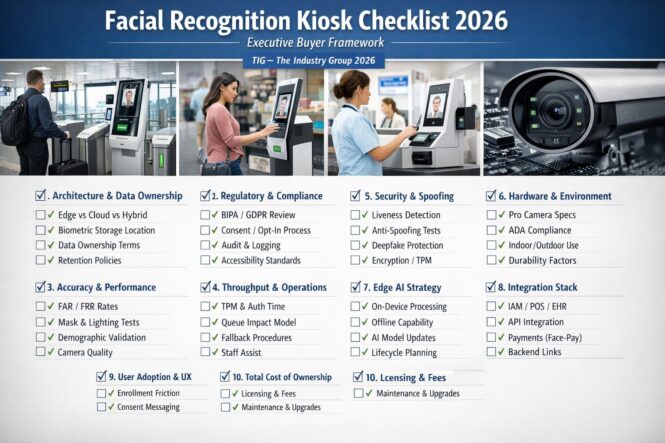
Executive Checklist
1Architecture & Data Ownership
- ☐ Edge vs Cloud vs Hybrid clearly defined
- ☐ Biometric templates stored where? (device / on-prem / cloud)
- ☐ Data ownership contractually assigned (not vendor-controlled)
- ☐ Retention + deletion policies documented
2Regulatory & Compliance
- ☐ BIPA (Illinois), GDPR (EU), and regional laws evaluated
- ☐ Explicit consent / opt-in workflows implemented
- ☐ Audit trail + logging enabled
- ☐ Accessibility (ADA / EN 301 549 / EAA) considered
3Accuracy & Performance
- ☐ FAR (False Accept Rate) meets use case threshold
- ☐ FRR (False Reject Rate) acceptable for throughput
- ☐ Performance validated across lighting / demographics
- ☐ Mask / occlusion handling tested
- FAR (False Accept Rate): Probability that the system incorrectly matches an unauthorized person.
FRR (False Reject Rate): Probability that the system rejects an authorized user.
4Throughput & Operations
- ☐ Transactions per minute benchmarked
- ☐ Average authentication time measured
- ☐ Queue impact modeled for peak usage
- ☐ Fallback flow defined (QR / PIN / staff assist)
5Security & Spoofing Protection
- ☐ Liveness detection (active/passive)
- ☐ Anti-spoofing certified (ISO/IEC 30107 or equivalent)
- ☐ Protection against replay / deepfake attacks
- ☐ Hardware root of trust (TPM 2.0 / secure enclave)
- ☐ Measured boot / remote attestation capability
- ☐ Full disk + biometric template encryption
- Liveness Detection: Techniques used to verify a real, live person is present (not a photo, video, or deepfake).
-
5A.Trusted Platform Security.
- ☐ TPM 2.0 or equivalent hardware root of trust present
- ☐ Secure boot chain enforced
- ☐ Remote device attestation supported
- ☐ Key storage isolated from OS (no software-only keys)
- ☐ Compliance with enterprise endpoint security policies
6Hardware & Environment
- ☐ Camera quality aligned with use case (not consumer-grade)
- ☐ Lighting conditions validated (indoor/outdoor)
- ☐ ADA height and reach compliance
- ☐ Environmental durability (heat, glare, vandalism)
7Edge AI Strategy
- ☐ On-device inference for latency/privacy
- ☐ Offline capability (network failure scenarios)
- ☐ AI model update strategy defined
- ☐ Compute platform lifecycle (5–7 years) validated
8Integration Stack
- ☐ IAM / identity platform integration
- ☐ POS / payments (face-pay?) integration
- ☐ EHR (healthcare) or enterprise backend integration
- ☐ API-first architecture
- IAM (Identity and Access Management): Enterprise system that manages user identities, authentication, and authorization.
- API (Application Programming Interface): Interface that allows the kiosk to integrate with backend systems such as payments, identity, or healthcare records.
9User Adoption & UX
- ☐ Enrollment friction minimized
- ☐ Clear user consent messaging
- ☐ Multi-modal fallback (don’t force biometrics)
- ☐ Cultural acceptance evaluated by region
10.Total Cost of Ownership.
- ☐ Hardware tiers (camera + compute) defined
- ☐ Licensing model (per user / per transaction) understood
- ☐ Maintenance + recalibration costs included
- ☐ Upgrade / obsolescence risk modeled
11.Europe.
What changes vs your checklist:
- Consent is mandatory (opt-in, not implied)
- Data minimization required (no “collect everything”)
- Storage scrutiny (cross-border data transfer issues)
- Auditability required (who accessed biometric data?)
- ☐ GDPR lawful basis defined
- ☐ Data Protection Impact Assessment (DPIA) completed
- ☐ Right-to-delete workflow implemented
- ☐ Accessibility compliance enforced (ADA / EN 301 549 / EAA)
12.Asia.
What changes:
- Facial recognition is often default UX, not optional
- Massive installed base + user familiarity
- Strong integration with payments + identity ecosystems
- Government influence on standards and deployment
Add to checklist:
- ☐ Face-pay integration (Alipay / WeChat Pay ecosystems)
- ☐ High-throughput optimization (sub-second auth)
- ☐ Ecosystem compatibility (super apps / national ID)
- ☐ Localization for dense urban environments
13.Japan & Korea.
More balanced:
- Higher privacy sensitivity than China
- Strong tech adoption but controlled rollout
- Retail + transit leading use cases
Add:
- ☐ Hybrid auth (face + card/mobile)
- ☐ Cultural UX sensitivity (non-intrusive flows)
14.LATAM Region.
What changes:
- Biometrics used for fraud reduction + identity verification
- Infrastructure variability (network, lighting, maintenance)
- Regulations exist (e.g., Brazil LGPD) but less uniformly enforced
Add to checklist:
- ☐ Offline capability (critical)
- ☐ Fraud / identity verification focus
- ☐ Environmental hardening (heat, dust, glare)
- ☐ Network resilience planning
15.Regional Deployment Overlay.
- ☐ Regulatory model (strict / moderate / permissive)
- ☐ Default UX (opt-in vs default-on)
- ☐ Identity ecosystem (isolated vs integrated)
- ☐ Network dependency level
- ☐ Cultural acceptance level
Definitions
Key Terms and Acronyms
- TPM
- FAR / FRR
- Edge AI
- IAM
- GDPR / BIPA / LGPD
- Trusted Platform Module (TPM) is a hardware-based security component embedded in a kiosk’s compute platform that establishes a root of trust for the entire system. In facial recognition kiosks, TPM securely stores cryptographic keys, verifies system integrity during boot (secure/measured boot), and enables device authentication and remote attestation, ensuring that biometric data and identity transactions are processed on a trusted, untampered device.
- GDPR: EU data protection regulation governing personal data and biometrics
- BIPA: Illinois law regulating biometric data collection and use
- LGPD: Brazil’s data protection law similar to GDPR
- ISO/IEC 30107 ISO/IEC 30107: International standard for biometric presentation attack detection (anti-spoofing).
- FIDO (Fast Identity Online): Passwordless authentication standard
- PKI (Public Key Infrastructure): Framework for managing encryption keys and certificates
- NIST: U.S. standards body influencing biometric and security guidelines
More Resources
- Edge AI – Curated hub that explores how edge AI, computer vision, and conversational interfaces are transforming self-service kiosks by improving performance, privacy, and real-time user interaction across industries.
- FAQ – What is a kiosk? Comprehensive, experience-driven knowledge base that answers practical questions on planning, deploying, securing, and optimizing self-service kiosks across industries like retail, QSR, and healthcare.
- Standards and Regulations — includes EAA checklist for 2026
- 2026 Compliance Architecture Framework for Self-Service — moving to mandate from recommendation