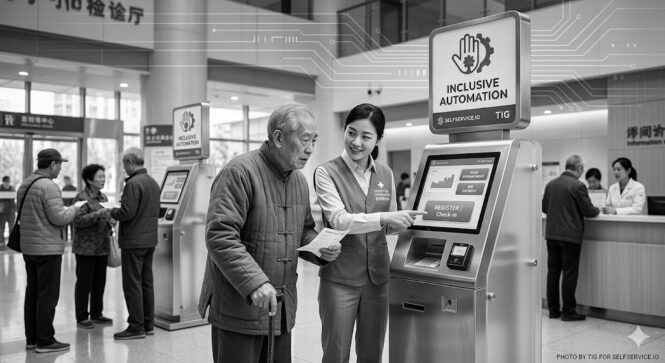
Designing Kiosks To Be Inclusive
Efficiency vs. Empathy: A Decade of Rapid Digitization
For ten years, the global healthcare mission has been clear: digitize or drown. From self-service registration kiosks and QR-code check-ins to automated payment platforms, hospitals have raced to eliminate administrative friction. The goal was noble—reduce wait times and streamline workflows to manage soaring patient volumes.
China has been the world’s “beta test” for this transformation. In urban centers, public hospitals have achieved near-total automation. Patients can theoretically book, pay, and access records without ever speaking to a human. But as we move into 2026, a glaring reality has surfaced: Efficiency for the provider does not always equal accessibility for the patient.
The 323 Million Person “Glitch”
As of early 2026, China’s population aged 60 and above has officially climbed past 323 million. While developers were busy designing sleek, minimalist mobile interfaces, they inadvertently locked out one of the largest demographic blocks on the planet.
For an elderly patient, a “seamless” QR-code workflow isn’t a shortcut; it’s a wall. When a hospital mandates a mobile-first approach, they aren’t just adopting tech—they are shifting the burden of labor onto the patient. This is the Digital Divide Paradox: The more we automate to improve “operational efficiency,” the more we risk disenfranchising the very people who need care the most.
The “Hospital Companion”: A Human Patch for a Software Bug
The most telling sign of UI failure is the rise of the “Hospital Companion.” These professionals are now a staple in Chinese healthcare, acting as high-touch navigators for the digital age.
Think of them as a human “override” for systems that are too complex. They assist with:
-
The Kiosk Hurdle: Navigating multi-step registration flows.
-
The Digital Maze: Guiding patients through departments based on app-driven routing.
-
The “Invisible” Bill: Managing digital-only payment processes that lack physical confirmation.
The existence of this industry is a direct indictment of current healthcare IT design. If a system requires a paid human guide to operate it, the system hasn’t been automated—it has been over-complicated. It proves that in healthcare, automation cannot exist in a vacuum; it requires a human safety net.
Designing for the 75-Year-Old, Not the 25-Year-Old Developer
The shift we are seeing in 2026 is a move toward Inclusive Automation. For healthcare IT leaders and kiosk manufacturers, the mandate has changed from “How fast can we check them in?” to “How many can we check in without help?”
-
The Hybrid Mandate: Moving away from “mobile-only” to “mobile-first, kiosk-always.”
-
Cognitive UI: Implementing larger text, voice-guided interaction, and simplified, linear workflows that mirror natural conversation.
-
The Concierge Model: Reimagining the “Information Desk” not as a place to hand out maps, but as a digital support hub where staff help patients bridge the tech gap.
The Global Regulatory Wake-Up Call
The U.S. and European markets are watching. Unlike the rapid-fire deployment seen in Asia, Western markets are tethered to strict accessibility mandates like the Americans with Disabilities Act (ADA) and Section 508.
These aren’t just “compliance checklists”—they are blueprints for survival. A kiosk without audio assistance or a screen reader isn’t just a liability; it’s a broken tool. As global healthcare systems merge, the lesson from China is clear: Technology must adapt to the patient, or the patient will simply go elsewhere.
The Bottom Line: Automation is the Tool, Not the Goal
The future of hospital automation won’t be won by the company with the flashiest app. It will be won by those who can blend high-tech efficiency with high-touch inclusivity. Success in 2026 is defined by Universal Access—ensuring that “frictionless” healthcare doesn’t leave the most vulnerable patients behind in the lobby.
More Resources
- Acer Repositions With Posiflex Buy
Implications for Posiflex Group (Posiflex, Portwell, KIS) TAIPEI (February 21, 2025), Acer Inc. (TWSE: 2353) announced plans to acquire 25.6% of …
- Phygital 2.0: When AI Becomes Retail Infrastructure
From “Unmanned Stores” to Intelligent Retail Systems Around 2018, the global retail industry became fascinated with the idea of the “unmanned …
- Edge Computing AI and the Future of Self-Service Infrastructure
Edge Computing – Hardware and Software Across the global self-service industry, kiosks are no longer simple transaction machines. In 2026, many …
- Best POS for Small Restaurants (and ones to Avoid)
Top POS for Small Restaurants Based on the article from Kiosk Industry, here is a summary of the top-rated restaurant POS …
End of Content