Around 2018, the global retail industry became fascinated with the idea of the “unmanned store.” Retailers began experimenting with cashierless checkout systems, computer vision technology, and automated payment kiosks. The goal was simple: reduce labor costs while improving customer convenience.
However, many of these early projects focused primarily on automating the checkout process. While removing the cashier improved efficiency, the rest of the retail infrastructure—inventory systems, supply chain logistics, and merchandising strategies—often remained unchanged. As a result, the early unmanned store model proved difficult to scale beyond pilot deployments.
By 2026, the industry has moved beyond this phase into what analysts now describe as Phygital 2.0. In this new stage, artificial intelligence is no longer limited to front-end applications. Instead, AI is becoming a core infrastructure layer connecting physical stores, digital platforms, and logistics networks.
AI as the Backbone of Retail Operations
Modern retail environments increasingly rely on AI-driven analytics and real-time data processing. Edge computing devices deployed in stores collect information from cameras, sensors, payment terminals, and digital displays.
These systems allow retailers to analyze customer behavior patterns, monitor product availability, and adjust promotions dynamically. For example, AI vision systems can detect when shelves are running low on inventory and automatically trigger restocking alerts. At the same time, digital signage can update promotional messages based on customer demographics or real-time demand.
The result is a retail environment that operates with continuous data feedback, allowing stores to respond quickly to changing consumer behavior.
The Rise of Agent-to-Agent Retail Systems
One of the key technological developments supporting this transformation is the emergence of Agent-to-Agent (A2A) architectures.
In an A2A system, multiple specialized AI agents perform different tasks and communicate with each other. One agent may focus on product recommendations, another on demand forecasting, while others manage warehouse logistics or marketing automation.
Major digital commerce ecosystems such as Alibaba and JD.com are actively experimenting with these distributed AI systems. By allowing autonomous AI agents to exchange data and coordinate decisions, retailers can create a self-optimizing operational environment that reacts quickly to demand fluctuations and customer preferences.
Digital Humans and New Forms of Customer Engagement
Another visible development in modern retail is the use of multimodal digital humans.
For example, JD.com has developed a virtual host known as Yanxi. This AI-powered digital assistant can host livestream shopping events, answer customer questions, and explain product features using natural language interaction.
Unlike traditional chatbots, digital humans combine several advanced technologies including speech recognition, computer vision, and generative AI. They are capable of interacting with both online audiences and in-store customers through smart displays or kiosks.
These systems can operate 24 hours a day and support thousands of simultaneous interactions. In many cases, digital hosts can operate at approximately one-tenth the cost of human staff, making them an attractive option for retailers operating large-scale livestream commerce platforms.
The Role of Kiosks and Edge Computing in Smart Stores
While cloud AI platforms handle large-scale data analysis, edge computing devices inside physical stores remain essential for real-time retail operations.
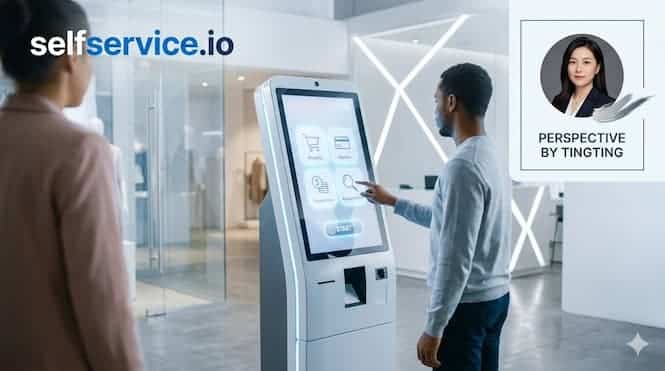
Smart kiosks, self-service terminals, and compact industrial mini PCs serve as the local processing layer within the retail infrastructure. These devices connect cameras, touch displays, sensors, and payment systems while running AI inference models directly at the edge.
By processing data locally, edge systems reduce network latency and allow stores to respond immediately to customer interactions. For example, a kiosk may identify a customer’s product selection, retrieve pricing data, display recommendations, and complete a payment transaction within seconds.
Compact computing platforms such as mini PCs are increasingly used because they provide high computing performance in a small form factor, making them suitable for embedded retail environments like vending machines, self-checkout stations, and smart kiosks.
Real-World Examples of AI-Driven Retail
Several retail companies are already demonstrating how AI infrastructure can reshape the shopping experience.
One well-known example is Amazon’s Amazon Go stores. These locations use computer vision, sensor fusion, and machine learning algorithms to enable a “Just Walk Out” shopping experience, where customers can pick up items and leave without traditional checkout.
In China, Alibaba operates the Hema (Freshippo) supermarket chain, which integrates mobile ordering, automated warehouse fulfillment, and in-store analytics. Customer data from the mobile app feeds directly into inventory systems, enabling rapid restocking and personalized promotions.
Meanwhile, JD.com has been expanding AI-powered logistics systems and digital human livestream hosts to support its rapidly growing e-commerce ecosystem.
These examples illustrate how AI is no longer a single feature but a multi-layered infrastructure connecting stores, digital platforms, and supply chains.
A View from China
From China’s perspective, the evolution toward Phygital 2.0 has been accelerated by the country’s unique digital ecosystem. High mobile payment adoption, large-scale e-commerce platforms, and the widespread popularity of livestream commerce have created an environment where new retail technologies can be deployed at scale.
Companies such as Alibaba and JD.com are using AI agents, digital humans, and intelligent logistics systems to create highly integrated retail infrastructures. Their large-scale experimentation provides valuable insights into how physical retail and digital intelligence may converge in the future.
As these technologies mature, the concept of the “Sentient Store”—a retail environment where AI continuously analyzes, predicts, and optimizes operations—may become a defining model for the next generation of global retail systems. China’s experience demonstrates that AI is not merely enhancing retail interfaces; it is becoming the core infrastructure powering the future of commerce.
More Resources
- Edge Computing AI and the Future of Self-Service Infrastructure
Edge Computing – Hardware and Software Across the global self-service industry, kiosks are no longer simple transaction machines. In 2026, many …
- Best POS for Small Restaurants (and ones to Avoid)
Gemini said Based on the article from Kiosk Industry, here is a summary of the top-rated restaurant POS systems for small …
- LG Kiosk at CSUN next week with Dot
CSUN – See LG Kiosk with Dot Inc. – Accessible kiosk LG at CSUN with Dot Braille Two notable things stand out: …
- Mini PCs Are Replacing Traditional PCs Inside Self-Service Kiosks
Why Mini PCs Are Replacing Traditional PCs Inside Self-Service Kiosks in Asia Across China and the wider APAC region, the computer …