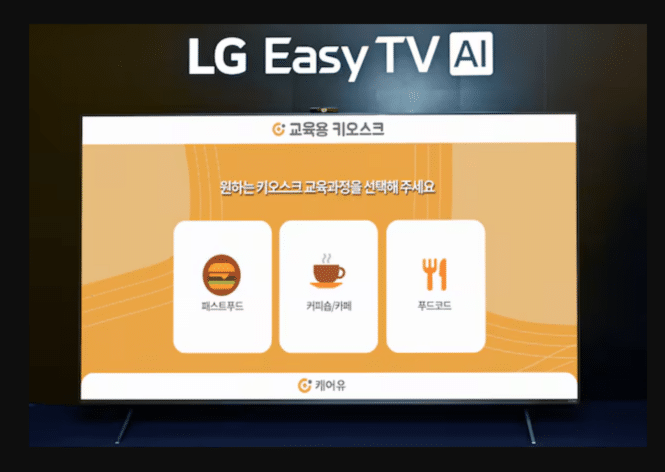
LG Electronics Launches Kiosk Practice Service for Seniors on TV
It’s significant because it treats kiosk literacy for seniors as a mainstream “home appliance” feature, not a niche training program, and it fits into a broader accessibility and aging‑society strategy for LG and for Korea.
Why this matters strategically
-
It acknowledges kiosks as basic infrastructure. When only 17.9% of Koreans 65+ say they can use kiosks for ordering/registration, they are effectively excluded from a big chunk of everyday commerce. Turning kiosk training into a TV app reframes it as essential life‑skills support, like remote health or medication reminders.
-
It extends LG’s senior platform. Easy TV was already a senior‑focused product with simpler UI, larger fonts, and services like LG Buddy for remote family support and reminders. Adding kiosk practice and brain‑health games deepens that ecosystem rather than being a one‑off feature.
Implications for kiosks and self‑service
-
It directly addresses the “fear and friction” barrier. Seniors can rehearse kiosk flows (burger QSR, café, food court) end‑to‑end—from item selection through payment—without time pressure, queues, or social embarrassment. That’s the biggest psychological blocker in real stores.
-
It builds a training channel retailers don’t control. Instead of retailers installing special training kiosks, training moves upstream into the home; in theory, chains could later co‑design TV scenarios that match their own UIs. This opens a new B2B content/partnership angle for LG.
Business and market angle
-
It differentiates LG in an aging‑market race. South Korea, Japan, the US, and EU are all dealing with rapidly aging populations; LG has already said Easy TV is intended for export to those markets. Kiosk training plus brain games and Buddy give LG a clearer senior‑lifestyle value proposition than “just a simpler TV.”
-
It complements LG’s own kiosk hardware strategy. LG is promoting more accessible kiosk designs (larger touch targets, better UX, etc.). Teaching seniors kiosk mental models at home makes it more likely that LG‑style kiosk UX conventions become the default “learned” pattern in the population.
Policy and accessibility significance
-
It aligns with government concern over the digital divide. Korea has already been running kiosk‑training programs through senior centers because older adults struggle with digital self‑service in a “contact‑free” culture. By quantifying the gap (only 17.9% confident users) and productizing a response in a mass‑market TV, LG positions itself as a private‑sector partner in digital inclusion.
-
It normalizes “practice mode” as part of UX. If this model spreads, you could see kiosk “simulator” apps on TVs, tablets, and phones become an expected accessibility feature, similar to screen readers or high‑contrast modes today.
From our kiosk‑industry lens, the interesting question is whether large QSR/retail brands will start co‑developing LG‑style at‑home training experiences that mirror their own flows—do you see clients being willing to invest in that kind of pre‑store training content?
From Chosun March 2026
A service has been launched allowing seniors to practice using kiosks (unmanned payment devices) on TV beforehand.
LG Electronics announced on the 29th that it will introduce the ‘CareU’ service, which enables kiosk ordering practice on the ‘LG Easy TV.’ Currently, the service is only available on the ‘LG Easy TV,’ a senior-friendly TV released last year by LG Electronics, reflecting feedback from senior customers.
The kiosk practice service was developed to assist senior customers struggling with complex screen layouts and unfamiliar payment procedures. According to the Ministry of Health and Welfare’s ‘2023 Senior Citizens Survey,’ only 17.9% of those aged 65 years old and older responded that they could use kiosks for ordering and registration.
The ‘CareU’ service is designed to help users easily learn kiosk usage in various situations by realistically implementing three everyday kiosk environments: hamburger restaurants, cafes, and food courts. For example, users can experience the entire process—from selecting food to payment—by placing an order via a kiosk at a hamburger restaurant, as demonstrated on the screen. LG Electronics stated, “We planned this service to help senior customers practice using kiosks comfortably at home, thereby boosting their confidence in using digital devices and making kiosk usage easier.”
LG Electronics has also incorporated brain health games for senior customers into not only the ‘LG Easy TV’ but also the ‘StandbyMe 2’ and ‘StandbyMe Go’ devices. The company plans to sequentially expand the application of the ‘LG Buddy’ and brain health games to other LG smart TVs.