Asia and Korea Accessibility Regulations
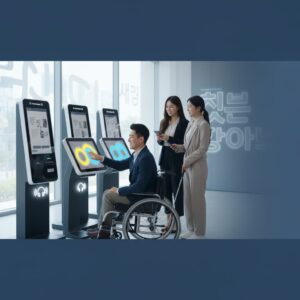
Starting Wednesday, most venues across South Korea that use automated kiosks will be required to install models accessible to people with disabilities. The move is part of a broader expansion of accessibility regulations as self-service systems continue to proliferate nationwide.
Under the updated standards, accessible kiosks must offer features such as voice guidance, braille or raised buttons, and adjustable screens or heights to accommodate users with visual or mobility impairments. Smaller businesses that qualify for exemptions can fulfill the mandate through alternative means, such as providing assistive devices or staff assistance.
The new requirement stems from a 2021 amendment to Korea’s disability discrimination law, which mandates reasonable accessibility accommodations in kiosk design and operation. Implementation has been phased in to reduce the burden on businesses.
The rule first applied in 2024 to public institutions and large workplaces with 100 or more full-time employees. It was extended last year to smaller businesses, which were granted a one-year grace period ending this week.
“In an era when kiosks are everywhere, guaranteeing access to information is not optional but a basic right,” said Lee Seu-ran, First Vice Minister of Health and Welfare. Lee added that central and local governments will work together to ensure the policy is enforced so that people with disabilities are not inconvenienced in daily life.
Exemptions apply to small establishments with less than 50 square meters of floor space or those that fall below industry thresholds for employee count or average sales. Such businesses may comply by offering alternatives including assistive devices, support staff, or a call bell. Failure to do so may result in complaints filed with the National Human Rights Commission of Korea and administrative fines of up to 30 million won (about $27,100).
The adoption of self-order kiosks in restaurants has surged in recent years, driven by efforts to cut labor costs and promote contactless service. A 2024 Korea Rural Economic Institute survey reported that the share of food service businesses using automated ordering systems climbed from 1.5 percent in 2019 to 12.9 percent in 2024. Among them, self-order kiosks made up 54.8 percent, far exceeding smartphone-based ordering at 35.6 percent.
However, many people with disabilities continue to face challenges. A Ministry of Health and Welfare survey conducted from 2024 to 2025 found that 161 of 540 respondents with disabilities had difficulty using kiosks. Of those, 80.1 percent cited automated ordering machines as the most difficult, followed by self-payment machines and ticket dispensers.
The most common frustrations included feeling rushed by waiting customers (54 percent) and trouble locating buttons or navigating menus (26.1 percent). Nearly 45 percent of kiosk users with disabilities said they preferred face-to-face assistance—more than double those who favored kiosks.
Similar accessibility measures are emerging abroad. The European Accessibility Act, passed in 2019, took effect last year to set minimum accessibility standards for products and services including self-service payment terminals. In the United States, while the Americans with Disabilities Act (ADA) does not establish detailed technical standards for kiosks, the Department of Justice has issued guidance requiring that such machines be operable with one hand and provide audible instructions for all functions.
More Korea Accessible Kiosk
-
South Korean startup Dot Inc. is also working to make digital interfaces more inclusive through its Dot Pad, a smart tactile graphics and multiline braille display that lets blind and low-vision users explore text, images, maps, and other on-screen content through touch. https://www.dotincorp.com/en/product/pad
LG is also pushing accessibility in self-service with its new Gen 2 self-ordering kiosks, developed with accessibility experts and featured on Kiosk Industry. These units build in inclusion from the start with motorized height adjustment, tactile input, voice guidance, and support for screen readers like JAWS for Kiosk, enabling blind, low-vision, and wheelchair users to order independently. https://kioskindustry.org/lgs-next-gen-kiosks-advance-a-better-life-for-all/