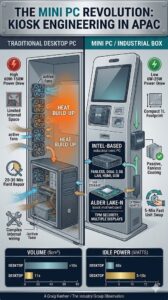
Why Mini PCs Are Replacing Traditional PCs Inside Self-Service Kiosks in Asia
Across China and the wider APAC region, the computer inside a kiosk is getting smaller. Five to eight years ago, many self-service machines used full-size desktop PCs mounted inside the cabinet. Today, more OEMs are choosing mini PCs, thin clients, or compact industrial boxes instead.
This shift is not only about hardware trends. It reflects how Asian operators manage space, cost, power consumption, and long-term maintenance across large deployments.
What Is Inside a Kiosk Today in Asia?
In China, most newly deployed kiosks use one of three computing types:
-
x86 mini PCs
-
Android boxes (ARM-based)
-
Fanless industrial embedded PCs
On platforms such as Alibaba and 1688, compact x86 systems from brands like Beelink, Shenzhen MeLE Technologies, and Shenzhen JWIPC Technology are widely listed for kiosk, POS, and digital signage use.
These units are typically small form factor boxes with SSD storage, multiple USB ports, dual HDMI outputs, and support for Windows or Linux. Many are fanless or use low-noise cooling systems designed for 24/7 operation.
Compared with a traditional desktop tower, these mini PCs are often no larger than a paperback book. They can be mounted behind a display, inside a narrow cabinet, or on a VESA bracket.
Why Mini PCs and Thin Clients Fit Kiosks
Size and Mounting
Space inside a kiosk is limited. Designers must fit printers, QR scanners, bill acceptors, card readers, speakers, and power modules in a compact enclosure.
A mini PC can be fixed behind the screen or on the side wall of the cabinet. This simplifies internal wiring and allows thinner, more modern kiosk designs. For OEMs competing on appearance and footprint, this is a major advantage over bulky desktop PCs.
Power and Heat
Traditional desktop PCs often consume over 150W under load. In contrast, many mini PCs based on low-power processors operate between 10W and 30W.
Lower power consumption means:
-
Less internal heat
-
Smaller cooling fans
-
Reduced dust intake
-
Lower failure rates
In hot and humid regions such as southern China or Southeast Asia, heat management directly affects reliability. Lower-power systems help maintain stable operation in non-air-conditioned environments.
Reliability and Maintenance
Mini PCs usually rely on SSD storage and have fewer moving parts than desktop towers. If a unit fails, technicians can replace the entire box quickly without disassembling the kiosk.
For operators managing hundreds or thousands of terminals, fast swap-out capability reduces downtime and labor cost.
Cost and Supply Chain Advantage
China’s electronics ecosystem allows mini PCs to be produced at large scale with competitive pricing. OEMs can source standardized hardware quickly without waiting for customized motherboard production.
This availability makes mini PCs attractive for projects that require fast rollout across multiple cities.
The Role of Intel-Based Mini PCs
Many kiosks in Asia still use x86 architecture because retail and government software often runs on Windows. Mini PCs using processors from Intel, including N-series or compact Core-based platforms, are common.
For self-service applications, this provides:
-
Smooth 1080p or 4K video playback
-
Dual-screen support (operator + customer display)
-
Stable USB connectivity for scanners and payment devices
-
Long lifecycle availability
In most kiosk scenarios, a low-power Intel mini PC delivers sufficient performance without the excess power draw of a full desktop.
Examples from China and APAC
Supermarket Self-Checkout
Large Chinese supermarket chains are deploying compact self-checkout stations. These machines must support barcode scanning, weighing scales, digital receipts, and payment terminals. A mini PC provides enough computing power while fitting inside a slim checkout frame.
A traditional desktop PC would increase cabinet size and cooling requirements without improving functionality.
Metro and Transit Ticketing
Metro ticket vending machines in cities across China and parts of Southeast Asia operate nearly 24 hours a day. Space inside these cabinets is limited due to cash modules and ticket printers.
Fanless mini PCs reduce dust intake and handle continuous operation more effectively than larger desktop systems.
Hospital Registration Kiosks
Public hospitals in China are expanding self-service registration and payment kiosks. These systems integrate ID card readers, QR scanners, and thermal printers.
Mini PCs allow quick hardware replacement if needed, which is critical in high-traffic medical environments.
Personal Observation: China vs. Western Hardware Choices
From my observation, Chinese kiosk manufacturers focus strongly on cost efficiency, compact design, and fast deployment. The hardware must be affordable, easy to replace, and stable under continuous use.
In Western industry , there is often more emphasis on brand-name industrial PCs and rugged certifications. In China, many operators are comfortable using reliable local mini PC brands if they meet performance and stability requirements.
Price, space efficiency, and low power consumption are often more important than brand prestige. As a result, mini PCs and thin clients are becoming the default computing platform inside self-service kiosks across China and much of APAC.