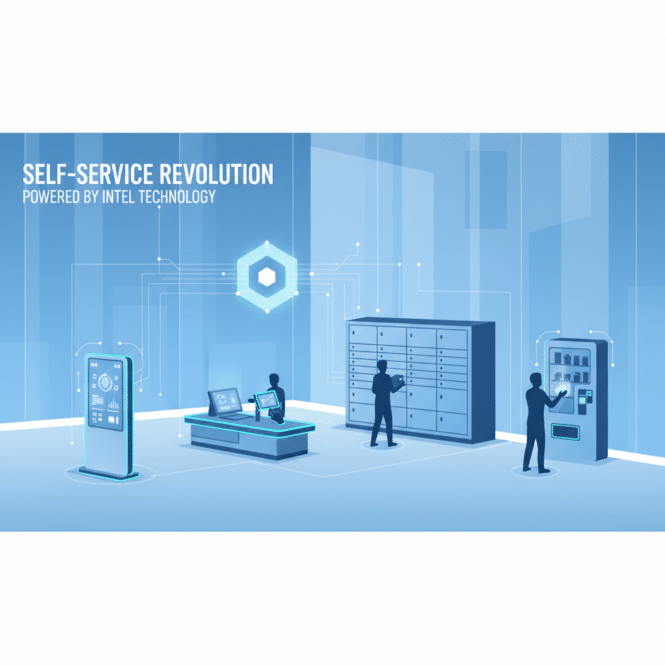
KIOSK Information Systems and Intel: Advanced Self-Service at the Edge
Intel is quietly but aggressively deepening its role in self-service, moving beyond “inside the box” CPUs to become a visible co‑brand on self-checkout, returns kiosks, and fully autonomous stores. At NRF 2026, the company and its partners framed self-service as one of the primary proving grounds for edge AI in retail, with kiosks and SCO terminals as the front line.
KIOSK Information Systems and Intel: Advanced Self-Service at the Edge
KIOSK Information Systems continues to be one of Intel’s flagship self-service partners, with “Advanced Self-Service Kiosk Solutions” featured in Intel’s solution library. KIOSK is leveraging Intel processors, IoT platforms, and vPro remote management to support large fleets across retail, banking, hospitality, and healthcare, with emphasis on security, health monitoring, and lights‑out servicing at the edge.
At NRF 2026, Intel highlighted KIOSK as a core example of “retail reinvented,” tying together self-checkout, returns automation, click‑and‑collect, endless aisle, and digital signage into a single self-service fabric. The message: kiosks are no longer standalone islands, but managed edge endpoints plugged into a broader Intel‑powered retail infrastructure.
AI-First Self-Checkout: WINTEC and Partner Tech
On the self-checkout front, Intel is leaning into AI‑assisted SCO rather than just faster CPUs. WINTEC’s Smart Self‑Checkout for Loss Prevention and Food Recognition uses Intel Core processors and Vision AI to recognize items, address pricing errors, and reduce shrink at unattended lanes. The solution is positioned for both retail and restaurant sectors, with computer vision and QR‑based self-payment as standard rather than experimental features.
Partner Tech is taking a similar approach, showcasing a full line of self-checkout systems built on Intel Core, with AI used for analytics, fraud detection, and operational optimization. At NRF, these platforms are explicitly marketed as “frictionless self-checkout powered by AI,” signaling that the industry is moving from simple scan‑and‑bag to context‑aware, vision‑assisted transactions.
Autonomous Stores: Brysk and Vision AI
Intel is also putting its weight behind fully autonomous formats. The Brysk Autonomous Checkout concept, featured in Intel’s solutions library in February 2026, describes an always‑on “micro‑store” model where Vision AI monitors checkout, inventory, and customer experience in real time. The store is aimed at locations like campuses, offices, and hospitality, where a 24/7, no‑staff footprint is more valuable than a full staffed shop.
This is a notable pivot: instead of treating kiosks as single‑purpose devices, Intel is endorsing a model where a cluster of vision sensors, edge compute, and compact kiosks together act as a self‑service store in a box. For kiosk vendors, it opens a path to move “up‑stack” into autonomous store solutions rather than just shipping standalone units.
Self-Service as Intel’s Retail Front Door
The NRF exhibitor listing for Intel sums up the positioning: interactive kiosks, smart vending, self‑checkout, and dynamic digital signage are all now part of a unified edge retail portfolio that combines AI‑driven checkout, loss prevention, and customer analytics. Open‑source tools and reference packages (including self-checkout examples on Intel Retail’s GitHub) are meant to lower the barrier for OEMs and ISVs to build on this stack.
For the self-service ecosystem, the implications are clear:
-
Intel sees kiosks and SCO as marquee applications for edge AI, not just generic embedded compute.
-
Vision‑assisted loss prevention and food recognition are moving from pilot to product, led by partners like WINTEC and Partner Tech.
-
Autonomous micro‑stores such as Brysk’s design are emerging as a new category that blends kiosks, cabinets, and vision sensors into a single always‑open self-service footprint.